


It may initially seem like a stretch to most people that topics as varied as the collision of ancient tectonic plates; the twelve-thousand-year human inhabitation of a forested region prior the four-hundred year European colonization and unsettlement of that region; Napoleonic soldiers feasting on Merino sheep in Spain; nineteenth century American-imposed tariffs; Henry David Thoreau stoking a three-hundred-acre forest wildfire; and recent suburban land-use history should, together, guide how architects, engineers, and builders think about contemporary timber building. But there is no timber building without its forest. And there is no forest without its geology, its forest history, its ecological dynamics, and its associated human history. To understand timber building more fully is thus to value these myriad influences and thus to place timber building design in a nexus of forest history, forest ecology, and projections for the future forests. While forests and timber buildings are directly connected as a terrestrial ecology, they are inexplicably valued and treated as distinct in professional and pedagogical contexts. As a result, there are persistent gaps that partition important aspects of forest knowledge from pertinent timber building knowledge.
Gaps
On one hand, there is a knowledge gap within forestry regarding building dynamics—which harvested wood products could be utilized and the fate of those products once they enter the building industry. Default assumptions about market species, products, and durations predominate the industry. For instance, a more functionally diverse set of wood species could be utilized in timber building technics.[1] Likewise, there is a significant variability of design, specification, and construction quality that greatly impacts prospects for durability, disassembly, and reuse of timber buildings and building components—that is, the residency of time of harvested wood components in the above-ground timber building carbon pool. These are but two gaps in knowledge about building that nonetheless continue to shape key aspects of forestry pedagogies and practices. In parallel, on the building industry side, there is a larger knowledge gap among architects, engineers, and builders regarding forest history and stand dynamics—and how building may, or may not, support regional forest dynamics and futures. What timber building products, what building types, and what building durations would best suit a regional forest? Unquestioned market assumptions and demands tenuously fill the gaps between forest and timber building knowledge. This results in quite arbitrary, and often quite adverse, consequences for both forests and buildings.
The most common of these gaps pertains to what a forest is. For architects, engineers, and builders, a forest is commonly and loosely construed as a stand of trees; an agglomeration of timber awaiting harvest. This aligns with definitions and interpretations of forests that extend at least back to the 1700s and is the source of terms like timberland: land viewed as a stand of timber as a resource. This crude resource-centric view persists today and generally leads to a model of forest-building relations that has been characterized as “the tendency to apply increasing levels of top-down management to natural resources.”[2] Ecologists C. S. Holling and Gary Meffe further refer to this top-down approach as a “pathology of command-and-control management in natural resources.”[3] In this model, perceived needs and demands of the timber building industry drive the top-down, market-driven approach that in turn imposes those perceived demands on regional forests. This is the tradition of commodity-centric silvicultural practice. The market orientation of this tradition directly shapes how forests are both viewed and managed: as supply zones of extracted resource commodities and maximal growth & yield.
That timberland tradition is distinct from ecological definitions of a forest that observe multiple factors and systems as constitutional of a forest. A working ecological definition of a forest is: “a complex system composed of heterogeneous assemblages of individual agents (e.g., trees, animals, humans), closely interacting through flows involving markets, goods, and various other ecosystem services.”[4] This ecological definition more closely corresponds to the terrestrial reality of a forest. A tree plantation, by contrast, satisfies less of this ecological definition since a plantation is typically managed for a few forest components: as an even-aged stand of short-rotation timber that is cleared of its understory, fertilized for rapid growth, and clear-cut; conditions required for optimized growth and yield. A tree plantation does contain trees and relies on shared knowledge regarding tree growth and biology, but it is not managed for the full, complex adaptive attributes of a forest ecology that prove consequential for the manifold terrestrial dynamics and ecosystems services that forests can exhibit and that support many aspects of life on this planet.
“When is it a forest?” is another valid question.[5] There is an important temporal dimension to forest ecology. As we will see through a discussion of forest history, forests are continuously evolving. Forests are never static, equilibrated systems. For example, a stand might be clear-cut or knocked down by a hurricane or landslide, which creates growing space. Most forests will eventually regenerate, filling available growing space. And once it returns more fully, it will develop its complex adaptive attributes as it proceeds through its stages of stand development. As humans interact with the stand, its development will be altered in other ways, just as it will likewise be altered further in the coming decades of changing climates. Thus what, and when, is a forest a forest is a worthwhile topic to ponder as we begin to relate timber building technics to forest ecology.
Traditionally forests are not treated as ecological systems by architects, engineers, and builders but typically as an abstraction—a standing reserve of biomass material. Accordingly, there is nothing particularly well-informed about the ecology of market-centric timber building products. Architects, engineers, and builders generically refer to “wood” in their pedagogies, practices, and specifications for building. Typically, the most specific and explicit their concern gets is perhaps the volume, visual quality, and structural capacity of “wood” as a building material. This unspecific conception of “wood” in turn drives generic, market-driven silvicultural prescriptions and forest practices. It leads, in part, to homogenized forests and homogenized buildings. Forests rarely win in this model of forest practice.
The gaps between timber building and forests described above as a market-driven, top-down silviculture practice are at once the product and enabler of an extractive mentality. Like aspects of forestry, architecture, engineering, and construction management as traditionally taught and practiced are also an art and science of extraction. As with any extractive economy, the process of extraction depends upon a range of aloof abstractions and externalities: overlooked uneven economic exchanges, unequal ecological exchanges, and environmental load displacements that together tend to underdevelop the hinterland extractive zone while concentrating environmental and economic benefit in overdeveloped urban centers.[6] This highly uneven and asymmetric mode of production and exchange chronically disadvantages and disables rural contexts: it tends to weaken forest systems, rural economies, and, when submitted to intersectional social analysis, disproportionately impacts Indigenous women and other traditionally disadvantaged groups.[7] It is hard to fathom the possibility of a good building under such circumstances, dependent on the gaps of a take-make-fake-break paradigm.
In their book, A Critique of Silviculture, Klaus Puettmann, K. David Coates, and Christian Messier observe important distinctions, or gaps, between foresters and forest ecologists by noting their “contrasting views,” or what each sees when they walk into a forest, what literature they read, and who they talk to.[8] Foresters tend to see merchantable biomass growth and yields whereas forest ecologists see biodiversity, forest health, legacies of past disturbance, and future forest trajectories. In this regard, it is relevant to add architects, engineers, and builders to Puettmann et al.’s dyad of contrasting views. When architects, engineers, and builders look at forests, they tend to see what foresters see. Unlike a forester, though, architects, engineers, and builders are more likely to assume that the forest that surrounds them has always been there and perhaps has always had roughly the same structure and composition of species. The operative understanding of the term “forest” for them is often as generic and vague as the common use of the term “wood” or “tree.” This limited view of forests is a characteristic, enabling feature of the top-down, command-and-culture, commodity-driven silviculture that dominates timber building. In this view, there is limited, if any, appreciation of the specificity, or potential, of forest history, dynamics, and species, or how design could otherwise relate to forests.
By contrast, a bottom-up, donor-view of forests for architects and engineers will entail a shift in view from forests as standing resources to a view that adapts timber building to the dynamics of forests, more akin to what a forest ecologist sees in a forest. Understanding the basics of forest history and stand dynamics is essential to this adaptation of timber building technics to forests. Looking back at historical forest dynamics directly informs how to look at present—and future—forest dynamics. In this book, the aim is to link timber building practices to the inherent propensities and dynamics of these evolving forest stands. This will inevitably entail a more specific understanding of what timber and processes would augment forest ecology—what species, formats, and pulsing cycles of harvest and production—but moreover it will more generally alter core assumptions about how we should relate to land through building. A bottom-up, ecology-led view of forest and timber building relations offers another way forward for forest-building relations, but it requires a different pattern of thought and action, and a different framework for valuing forests and buildings.
The Hylomorphic & The Immanent
The gaps between forest knowledge and building knowledge are the result of certain thought traditions, particular philosophies that shape the pedagogies and practices of forestry and timber building alike. These traditions are not merely semantic differences in words but reflect foundational worldviews about the role of design, building, and forests in our world. One way to describe the prevailing philosophy in architecture and forestry is hylomorphic. According to philosopher Gilbert Simondon the hylomorphic model is a Western philosophical tradition in which human ideas are imposed on seemingly neutral world of matter and energy.[9] As Manual DeLanda describes this tradition, “one constant in the history of Western philosophy seems to be a certain conception of matter as an inert receptacle for forms that come from the outside.”[10] In this schema, transcendent forms derived through geometry and narrative are determined and designed in a manner independent and a priori to matter and energy. Think about a tree plantation as one example, which imposes one or two species, in a geometric arrangement on a landscape to achieve a particular imposed economic outcome. Think about timber building design as another example, which also imposes one or two species, in a geometric arrangement, to achieve a particular economic outcome. In both cases, human ideas, will, demands, and norms transcend the material and energetic dynamics of the world, which are treated as but the enabling substrate of human action and economy. Both forestry and timber building are hylomorphic in these examples.
In contrast to the dominant tradition of imposed, hylomorphic form, an immanent and materialist understanding of formation and appearance has developed over the past century in both science and art. In this alternative tradition, how things form and appear in this world is contingent on certain terrestrial propensities and processes, a philosophy that is more consistent with relational ways of knowing and practicing. As DeLanda observes, in this tradition the “resources involved in the genesis of form are immanent to matter itself.”[11] In other words, the material and energetic dynamics of the world are inherent to what appears in our world, and how. In the context of this book, it is apt that Gilles Deleuze and Felix Guattari use wood and wood artisans to describe immanent form and appearance:
[A]n artisan who planes follows the wood, the fibers of the wood, without changing location. But this way of following is only one particular sequence in a more general process. For artisans are obliged to follow in another way as well, in other words, to go find the wood where it lies, and to find the wood with the right kind of fibers. Otherwise, they must have it brought to them: it is only because merchants take care of one segment of the journey in reverse that the artisans can avoid making the trip themselves. But artisans are complete only if they are also prospectors; and the organization that separates prospectors, merchants, and artisans already mutilates artisans in order to make “workers” of them.[12]
Wood artisans must practice a more immanent relation to wood: from its acquisition to its grain to its final carved shape. In other words, wood is not merely a blank plank, awaiting the fancy of imposed shapes and structures. Rather, wood has inherent propensities that extend from the forest ecology to thermal properties and dynamics of carbon cycling that can help guide the formation and appearance of a timber building. However, note that in this immanent philosophy, a timber building design is not determined by these terrestrial contingencies and propensities, but it is understood as dependent on them. In an immanent world of design, designs are not imposed but emerge from a composite of carefully studied contingent conditions as matched with intended outcomes. When it comes to timber building, this synchronization of contingent conditions and intended outcomes requires much greater knowledge of forests. A forest-first view of timber building technics reflects a more immanent theory of design. A forest-view of timber building technics also reflects a unique way to value forest-building relations.
Receiver Theory of Value vs Donor Theory of Value
When architects often repeat that mass timber building depends on “sustainable forestry,” they implicitly make a value claim. Specifically, they claim that the value of a timber building is somehow contingent on purportedly valued forest dynamics, although they never state what those dynamics are or should be. Further, none of their subsequent research or working methods thereafter reflect this bio-geophysical contingency. The forest does not seem to have real value, in other words and methods. Instead, a range of market-oriented value propositions follow, usually focused on timber certification programs and loosely applied assumptions about the carbon storage potential of timber building products. In doing so, in methodological terms they abstract and externalize what all forests do, and could do, in their timber product-centric worldview. This is design as manifest in a world of imposed, specified products with market prices, driven by what the building industry demands. This conception of value will never yield an ecologically viable—or “sustainable”—model of forest practice or building practice.
A market-oriented conception of timber and forest value is categorized in ecological economics as a receiver theory of value. Regarding this type of valuation, Howard T. Odum observed that “market value, defined by what people are willing to pay, is the principal method of accounting used in economics. It is a value determined by the human receiver according to short-range needs and expected benefits…[but] market prices are not helpful for direct evaluation of contributions from the environment and often respond inversely (prices are least when [environmental] contributions are largest).”[13] This is a consumption-driven theory of value. In our market system, the willingness to pay perceived values cascades down a “chain” of consumers and suppliers from building owners to architects and engineers, to builders, product manufacturers, mills, and loggers. This model persists and thrives because dollar prices are lower when incomplete valuation of the bio-geophysical work of the planet drives the valuation. Or as Odum put it, dollar “prices are least when [environmental] contributions are largest.”[14] This is the base dynamic of unequal ecological and economic exchange in the building industry. Discursive references to the “supply chain” of a timber building is a common indicator of a receiver theory perspective in action: top-down, command-and-control material flows that supply the received consumer product. Notions of subjugation and servitude implied in “supply” as well the subordination and fettering of world systems implicit in the term “chain” chillingly convey the unjust history of receiver-oriented theories of value.
Other theories of value exist and better assess the bio-geophysical work of the planet, such as the work of forest ecology and the human labor involved. Odum’s systems ecology and world system descriptions were based on the fact that the real wealth of the planet—the bio-geophysical abundance of the planet—“needs a donor-determined value, a measure of what was required to make an item or service.”[15] As ecological economists Benjamin Lowe and Andrea Genovese summarize, “broadly, donor theories account for the objective resources utilized to produce an item or service; receiver theories link value to human demand.”[16] This entails the labor and terrestrial resources entailed in material production; what Odum what described as the real wealth and bio-geophysical contributions of a terrestrial ecology.
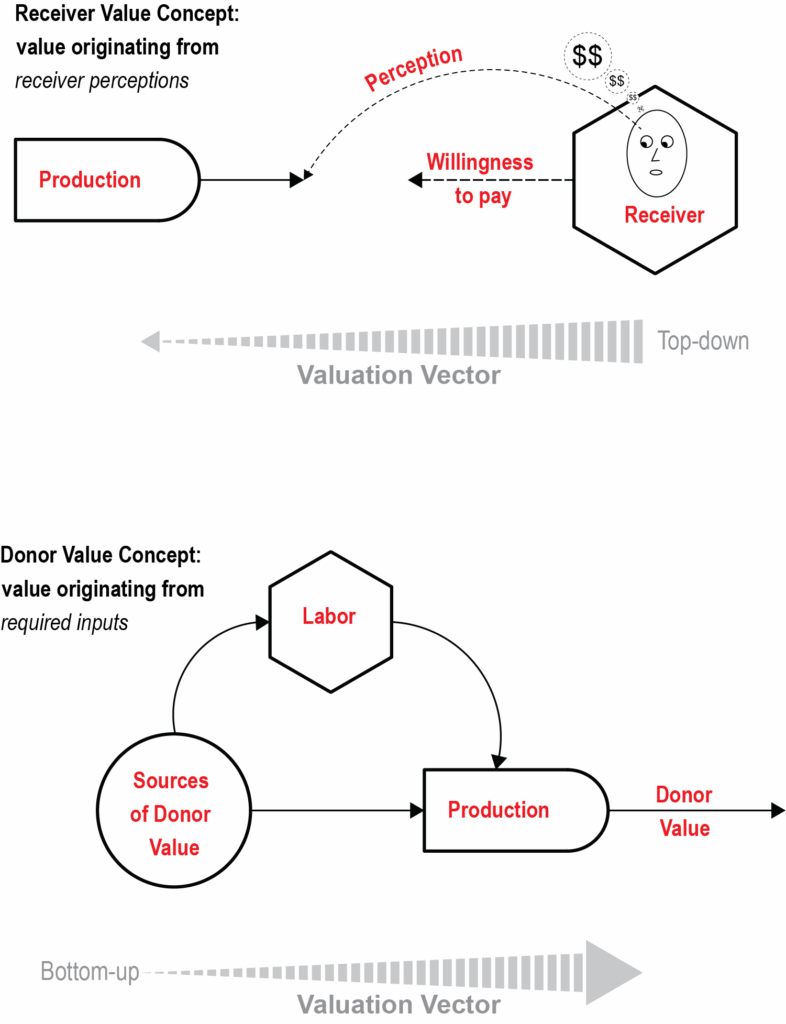
More valid conceptions of how timber buildings relate to forests require a donor theory of value. This in turn requires us to put the forest first. What bio-geophysical work of the forest is contributed to timber building? A forest ecosystem does far more than yield timber, or sequester carbon, or emit the oxygen we breathe. If we intend to better orient ourselves to our environment, if we endeavor to better synchronize our lives to the dynamics of the planet, then donor theories of value ought to help shape our decisions, lives, and what supports them. For example, donor theories of value should help shape our understanding, analysis methods, and designs for timber building, literally from the ground up. If we wish to link the carbon dynamics of timber buildings to the carbon dynamics of forests, for instance, then the forests must come first, as forests do the work of carbon sequestration—not timber buildings or their life-cycle assessments.
A donor-determined, forest-first view of value reflects less of a linear sequence of economic exchanges, and more of a nonlinear, convivial reciprocity of system values: what the bio-geophysical world donates to a timber building, and how a timber building could feedback and reinforce its terrestrial ecology rather extract and degrade it. No ecology, and no building ecology, is linear or circular. Building is inherently nonlinear in its convergence of material, energetic, and informational flows as well as its feedback in the system. The more our understanding of value reflects a nonlinear, convivial convergence of forest-building values, the more synchronized our reciprocal forest practices and timber building practices can become. This donor theory of value, when combined with a more immanent design philosophy, begins to reflect a worldview of design as a genre of belonging: an architecture of practices that belong to specific processes, places, and people. This, in turn, is the basis of a non-extractive approach to timber building technics.