


What is a material? How can we say what a material is? That’s a very difficult question to answer. It is easy to say, “That’s wood, that’s metal, that’s pewter, that’s tin.” But what are we talking about? What is wood, what is tin, what is copper? What do we mean when we speak of materials?
The scientific chemist, of course, will think of matter in terms of its invariant atomic or molecular constitution: water is two hydrogen atoms and an oxygen atom, salt is a sodium atom linked to a chlorine atom. Wherever you have water, or wherever you have salt, you have these atomic combinations. Water is an interesting case in point, however. The molecular structure could not be simpler, and yet the properties of water—what water does under different conditions—are still so complex as to defy full understanding. For example, nobody yet knows why ice is slippery. There’s a lot we don’t understand about chemically the simplest materials. They remain beyond our comprehension in terms of what they actually do. So the maker is less like a scientific chemist than an alchemist.
I have noticed, both in my own work and in the work of many colleagues, that as we become more interested in materials themselves and in what they do, we are also beginning to think more like alchemists, and to have greater respect for what the alchemists achieved. They were not so interested in what a material is. They wanted to know what it does, what happens to a material when you mix it with other materials, or heat it up, or cool it, or treat it in particular ways. This is also what a cook wants to know. A cook, experimenting in the kitchen, puts different ingredients together and looks to see what happens to them if you heat them or boil them, freeze them or cool them down. So the maker, working with materials, is like an alchemist: he’s interested not in what the materials are but what they do. In short, materials are what they do. So to define or specify a material is, in a way, to tell a story about what happens to it when it is treated in particular ways. For example, gold is an element in the periodic table, and the chemist or the scientist would define it as such. But if you were an alchemist you might say that gold yellows and gleams, that it shines ever more brightly under running water, and can be hammered into thin leaf.
In the 1960s the craftsman and furniture designer David Pye proposed a distinction between what he called the properties and the qualities of materials.[1] He argued that the properties of materials are given in what they are: they have a particular density, weight or tensile strength, which can be established through careful scientific testing or experiment. The qualities of materials, by contrast, are ideas in people’s heads: we ascribe certain qualities to things, but these are merely products of our imagination. But this only reproduces the division between mind and matter, which we want to try and get away from. I think it is better, if we are concerned with the properties of materials, to think of these properties as belonging to the knowledge of practitioners that comes from a lifetime of experience of working with them. And this means that when we talk about the properties of materials, they are really stories of what happens to them.
In a sense, we could say that materials don’t really exist; rather they carry on, or perdure, through time. Every material, in a way, is a becoming—it’s not an object in itself but a potential to become something. So to describe a material, I think, is to pose a riddle: it is a riddle that gives the material its voice, and then the answer is discovered by observation and engagement with what is there. Medieval texts are full of riddles of this kind. I could make one up for you, and it would go like this: “I yellow and gleam; I shine ever more brightly under running water. Hammer me, and I will get thin. What am I?” The answer can be found simply by observing—by looking around in the world and finding what answers to that description. We call it ‘gold.’ But we don’t need to have that word at all. We know what we are talking about through observation, through engagement in the world.
So the artisan, the craftsman, the maker, is someone who has to be ever-observant of the movements of stuff around him, and has to bring the movement of his or her own conscious awareness into line with the movements of the surrounding materials. Thus making something is a mode of questioning and response, in which the maker puts a question to the material, and the material answers to it; the maker puts another question, the material answers again, and so on. Each answers to the other. I use the term correspondence to capture this mutual responsiveness. In making, the maker follows the material, and that process of following the material is a correspondence between the flow of the material and the movement and flow of the maker’s consciousness. One could draw the flow of material as one wavy line, and the flow of consciousness as another, running roughly parallel. Correspondence, then, is a matter of bringing these two lines into agreement. To adopt a musical analogy, it is like two lines of melody responding to one another in counterpoint.
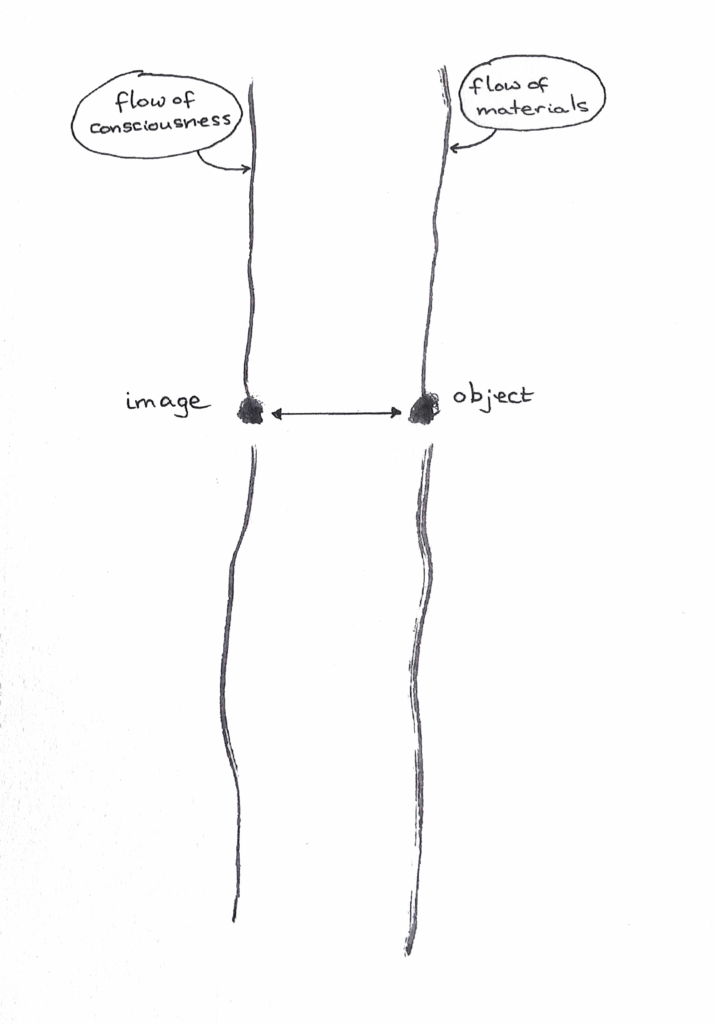
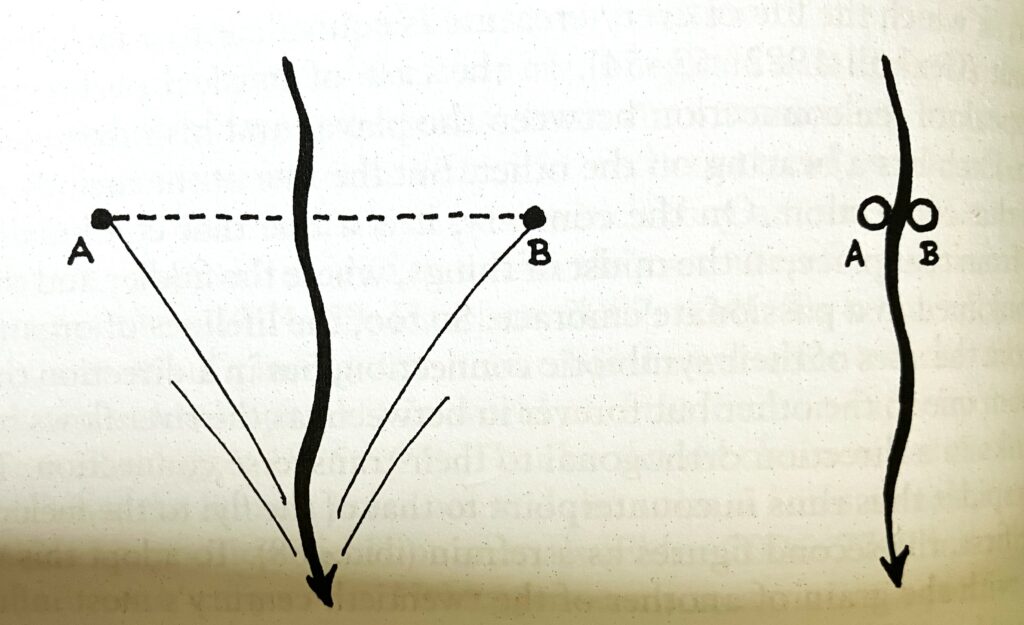
What I am against is the ‘freezing’ of the flow of materials in the form of an object, and the freezing of the flow of consciousness in the form of an image, leading to the idea that making is an interaction between image and object. For me, making is not about images and objects at all, but about the coupling of awareness, and of movements and gestures, with the forces and flows of materials that bring any work to fruition. The important thing to recognise about these flows is that they don’t connect things up. To adopt a helpful metaphor from Deleuze and Guattari, imagine a river flowing between its banks. You can imagine one place A on one side of the river, and another place B on the other side. And you could build a bridge and cross from A to B. The flowing water of the river, however, does not go from anywhere to anywhere else. It just keeps flowing along, between its banks, at 90 degrees to the line between A and B. It goes along, not across.
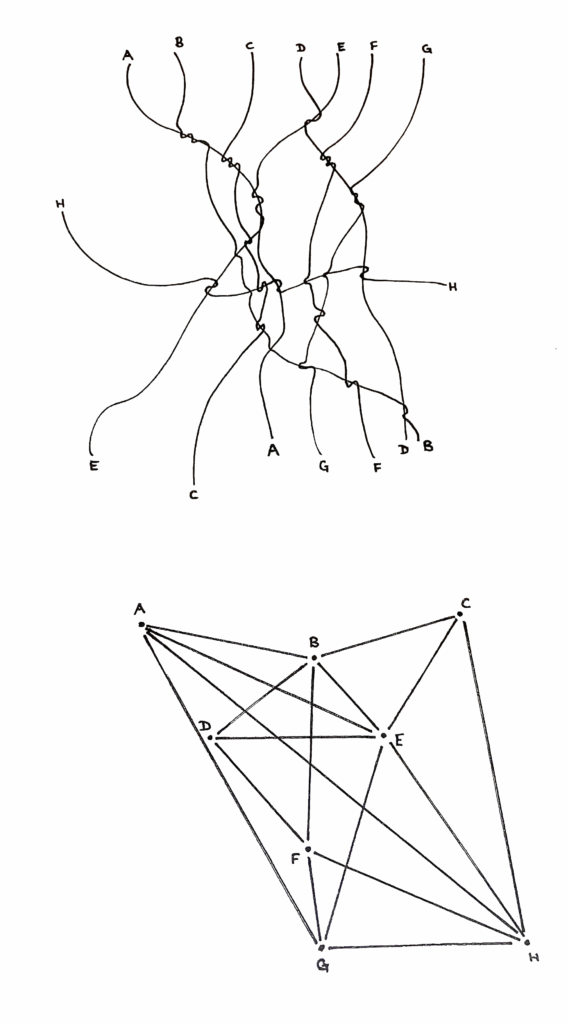
It is to these flows that we need to attend if we are to understand making. Whereas the lines we might draw between objects, or between objects and persons, are lines that connect—like the line across the bridge from A to B—the flow-lines of materials and awareness do not connect but entangle. They comprise not a network but a meshwork. To shift from talking about objects and their relations to materials and their entanglements is equivalent to a shift from a network view to a meshwork view. I think this meshwork view corresponds very closely to the ecologists’ idea of the web of life. And it means that we have to distinguish not only between objects and materials but also between objects and things.
This word ‘object’ is very problematic: it’s a word that many of us would like to be able to put to one side. It’s a problem firstly because you think: “where there are objects there must be subjects,” and the subject/object dichotomy has raised a host of difficult issues, not least that of the Cartesian split between mind and body. Most philosophers are agreed that the dichotomy has to go. But there are many rival philosophical camps, and each camp, while claiming to have solved the problem of how to get rid of the dichotomy, accuses its rivals of merely reproducing it in its discourse. For the onlooker to these arcane debates, it is all very tiresome. To my mind, however, the problem with the object, as indeed with the subject, lies not with the ob- or the sub– but with the –ject. It implies an entity that is already thrown, already cast, in a fixed and final form. It confronts us, face-to-face, as a fait accompli. When we talk about materials, on the other hand, they are always becoming. Everything is something, but being something is always on the way to becoming something else. Materials, if you will, are substances in becoming.
Thus the move from a focus on objects to a focus on materials is equivalent to a shift from a philosophy of being to a philosophy of becoming. Gatherings of materials in movement are what we call things. The distinction between objects and things goes back to the philosophy of Martin Heidegger. For Heidegger, the object is ‘out there,’ a fait accompli: you are ‘over against’ it.[2] The thing, by contrast, is to be understood as a gathering of materials in movement. So to touch or observe a thing is to bring the movements of our own being (or rather, becoming) into correspondence with the movements of the materials.
The final point I want to make is that if we think of things in that way—as gatherings of materials in movement—then we are things too. People—we—are living organisms, and as organisms, we too are gatherings of materials in movement. In fact, we are entire ecosystems. I believe that according to the latest studies, 90 per cent of the cells in the human body belong to various kinds of bacteria—but that’s another story. As gatherings of materials, people are a bit like compost heaps. If you were to take the lid off a human being you would see a writhing mass of activity going on beneath, like the writhing worms in a healthy heap of compost. And the thing about living bodies, human or non-human, is that they are sustained because they are continually taking in materials from their surroundings and discharging into them, in the processes of respiration and metabolism. Quite simply, to live we have to breathe; we also have to eat, and to defecate.
The organism can only keep on going because of this continual interchange of substance across its outer membrane or skin. Quite generally, things perdure—that is, they can carry on—because they leak, because of the interchange of materials across the ever-emergent surfaces by which they differentiate themselves from the surrounding medium. The bodies of organisms and indeed of other things leak continually; in fact their lives depend on it. And in my view this shift of perspective, from stopped-up objects to leaky things, is what ultimately distinguishes what I want to call an ecology of materials from mainstream studies of material culture.