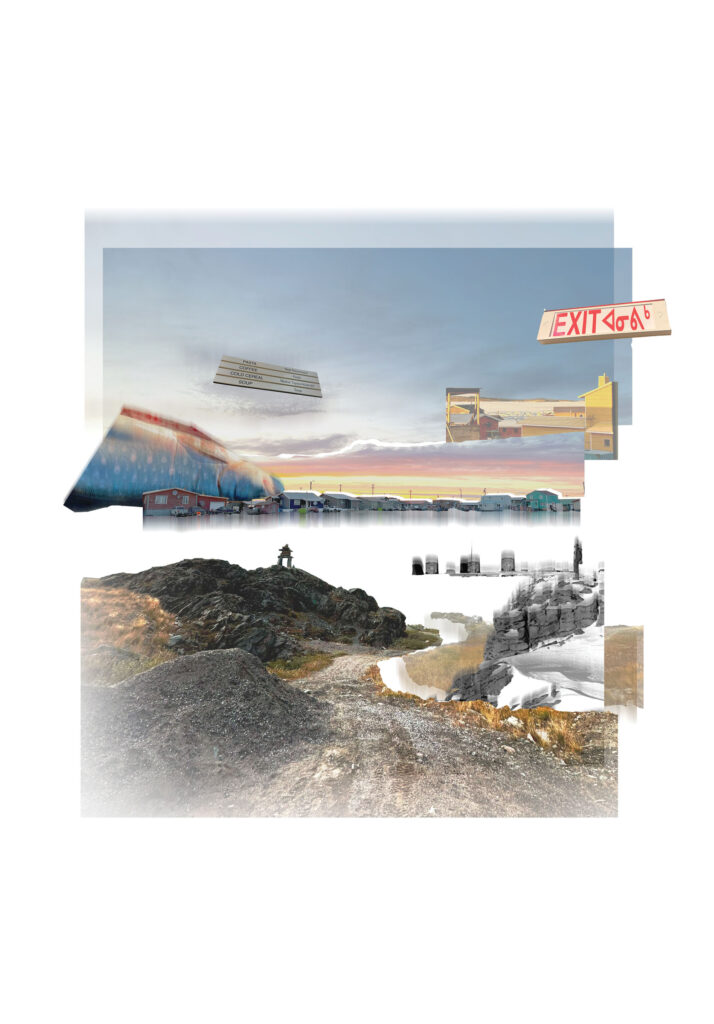



The territory of Nunavut is the most recent territory of Canada. It was created from the Northwest Territories on April 1, 1999, by way of two legal tools: the Nunavut Act and the Nunavut Land Claims Agreement Act. There are fifty-three communities within Nunavut, all created within the last century. Each of these communities has a distinct history in how and why they were created. Some are related to the existence of Hudson Bay Posts, and some are related to the location of residential schools and mines. Some are the result of forced relocation by the government, and some are near traditional hunting grounds. There are many other possible and related factors. But whatever the reason each community has come to be where they are, each settlement is rich with distinct Inuit culture. These communities face unique challenges as they become increasingly involved with southern and international developments while building capacity for their community members.
In the context of architectural development in the Arctic, Inuit and remote Indigenous communities have created a perplexing mismatch of timelines, as there are different perceptions of how development is seen and understood. Construction deadlines and Inuit culture and community timelines vary: companies and the government plan the completion of a project to certain dates or times of the year and then move on to the next job. Conversely, communities plan beyond the completion date, incorporating the building into their community life. There exists a kind of synergy between those designing and constructing and the users who inherit something ongoing, which companies and the government would instead consider an end result. Despite knowing this, the processes of architectural development and construction differ from project to project, continuing the misalignment of timelines and the friction between ideas of completion and care. These are my current observations as I navigate the architectural and construction realm early in my career. I look forward to comparing my observations again in the coming years.
In the past few decades, Indigenous architects and designers have become powerhouses in designing and advocating within the architecture realm, with and for Indigenous communities, an opportunity that wasn’t as common or even available in previous decades. I am pleased to say there has been a lot of movement with Indigenous architects in practice and academia, which inspires me to continue within the industry. Inversely, however, there has been a struggle to retain Inuit within the construction industry and on the job site. The Nunavummi Nangminiqaqtunik Ikajuuti (NNI) is a preferential procurement policy wherein the Government of Nunavut requires a certain percentage of Inuit or local workers, as this helps workers gain skills so that they then might continue to apply them within the community. NNI is meant to assist in local labor and generating local economy rather than solely relying on southern business. Unfortunately, a flaw in this policy emerges when the community experiences so much development that the demand for local labor outstrips the projections or quota conveyed to the local community. Depending on the population of the community and the type of work available related to construction, the percentage of applicable local labor can struggle to meet the minimum NNI percentage (which may vary from project to project); therefore, having southern workers becomes an important factor in the development of construction projects in these Arctic communities. In addition, there are also existing competing priorities that come in the form of seasonal pressures as hunting flourishes at only certain times of the year. Inuit—perhaps most Indigenous people—are faced with the need to balance working a day-to-day job to practice a modern lifestyle to support themselves within capitalistic systems with being on the land, freely practicing and maintaining their cultural skills, including obtaining sustenance through hunting, fishing, berry picking, etc.
It is something beyond irony when people need to work to provide for themselves and their families by purchasing groceries at super-inflated prices when the land and all that it contains is at their doorsteps. The mark-up on standard food items in Nunavut has long been known to be unfair due to the monopoly of grocery stores (in addition to the lengthy travel required for these items). We need to challenge this monopoly. If one had to choose between the working conditions of construction labor and being on the land, most of us agree that spending our days outdoors provides both much-needed therapeutic value and autonomy.
It is also worth noting that educational opportunities in the North are few; it is important to understand that the number of educators present is limited, and this is but one of many factors contributing to the need for specific careers and training. This is why we commonly see southern workers sent up for weeks or months at a time. Although this may be business as usual, this, too, adds to the need for more planning, increasing the demand and cost for flights, food, and accommodations in already housing-short and overinflated communities.
To even ship the needed construction materials on the limited number of ships that are able to travel before the ice sheets form is already an extreme cost factor to be considered in all northern construction. Each community relies on these same ships to deliver the diesel fuel that heats their buildings during the long, dark winters; every drop of fuel and second of warmth counts. It is a constant push and pull between resource and restraint.
In most cases, there are very limited spaces for Indigenous leadership and practice of autonomy related to culture and identity for roles within architecture, construction, and development. From my observations, and even though much work has been done, Inuit continue to be used to fill labor-intensive construction jobs with a very limited percentage of Inuit in management (i.e., running job sites). The lack of Indigenous autonomy continues to be glaringly obvious, even if we know better. In time, I hope to see this evolve into a range of roles readily available for Inuit in their communities to contribute to development at a variety of levels in planning. Representation matters.
Inuit have experienced unique introductions to the southern and global realms. It’s something I’m still learning. But what makes it special for me is that I am observing these young communities changing slowly in a way that works with them as they gain retention within the industry. This does not mean the process is perfect, but forward development is progressive. This is not to disregard the hardships of Inuit due to colonization—this should be a fundamental requirement for all architects and construction companies working in the Arctic to learn about—but this is an example of Inuit developing sovereignty for Inuit.
I used to perceive teaching and tradition as something of the past, but I now understand it is up to us—Inuit and Indigenous—to listen and apply our cultures respectfully, which inherently makes them modern. Not only am I continuously learning about my own Indigeneity, but I’m also learning what it means to be an architect and what it means to develop these identities to coexist.