


Developed within the Resilient by Design (RBD) initiative, the South Bay Sponge proposes a resilience framework that imagines new modes of climate adaptation for California’s South Bay. A multidisciplinary team collaborated with local communities to establish an equitable, living framework that can scale, attract investment, build public support, coordinate across jurisdictions, and contribute to broader regional resilience. The proposal envisions nature and technology working in tandem to strengthen urban resilience, social cohesion, and collective well-being. Marshlands, ponds, transitional and seasonal wetlands, and floodable parks—linked to both new and existing neighborhoods—operate as a vast “sponge,” absorbing and filtering floodwaters while providing habitat and biodiversity.
Early Findings and Research
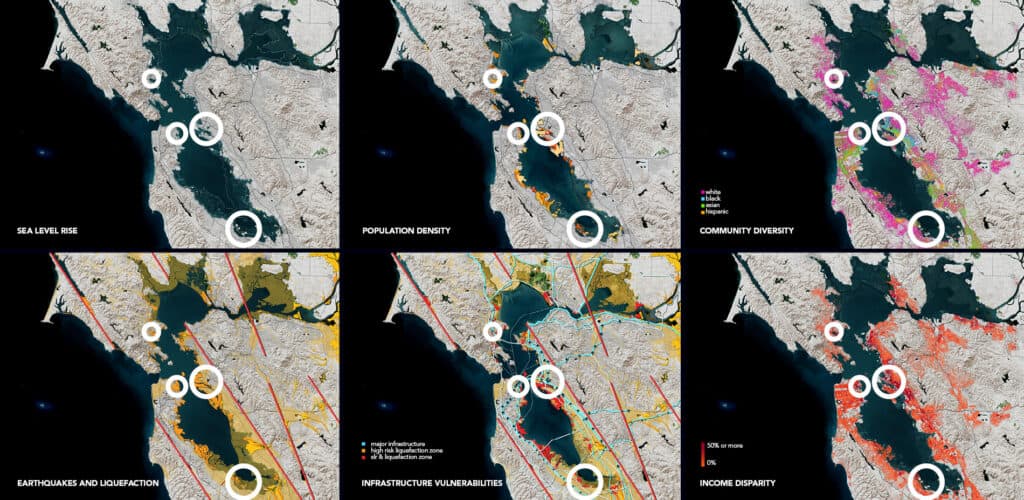
At the outset of Resilient by Design, the team set out to tackle current issues of climate change and sea level rise, environmental justice and social equity, urban livability and public benefits. Credit: Field Operations
As urban coastlines confront sea-level rise, flooding, and storm damage, the Sponge advances natural systems as primary tools for adaptation across the San Francisco Bay. Early “Baytowns” research surveyed multiple, distinct communities to understand converging vulnerabilities—climate risk, environmental justice, and urban livability—and to identify opportunities where resilience means the capacity to recover, adapt, and absorb stress with minimal loss.
The South Bay Sponge scales ecological infrastructure—restored marshes, salt ponds, and constructed wetlands—to collect, filter, and disperse storm waters while strategically building higher ground to support housing and transit. The framework integrates shoreline adaptation with mobility, housing delivery, and equitable planning, using design as a lever for connectivity, environmental performance, and social benefit.
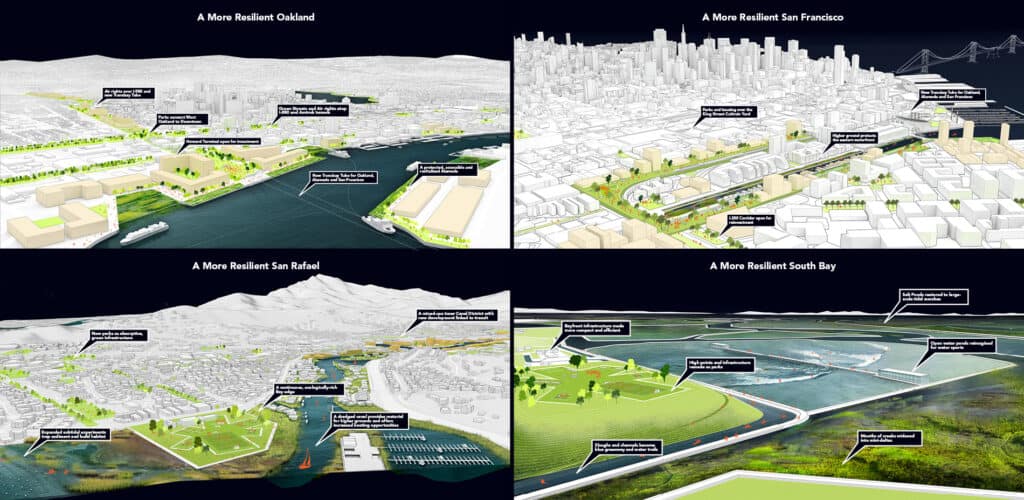
Baytowns
The early research effort, titled “Baytowns,” explored four different communities where many vulnerabilities and risks converge for communities with entirely different geographies and physical conditions around the Bay. The aim was to leverage these vulnerabilities into opportunities for greater resiliency.
Credit: Field Operations
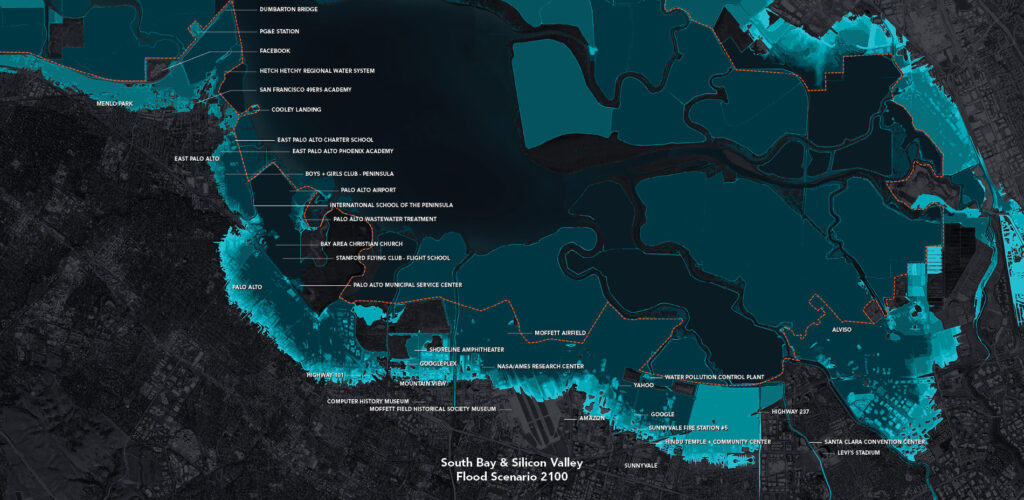
South Bay and Silicon Valley in 2100
The South Bay and Silicon Valley include some of the lowest-lying and most vulnerable communities to sea level rise in the Bay Area, and at the same time are growing rapidly without big plans for increasing housing and transit connectivity.
Credit: Field Operations
A year-long, open process centered vulnerable and disadvantaged communities through agency coordination, workshops, and direct resident engagement. The mobile “Sponge Hub”—an Airstream wrapped with a sponge super-graphic—brought ideas to neighborhoods across six cities and two counties, engaging over 1,000 people and creating a shared language around nature-based flood protection.
Spanning more than 20 miles and multiple jurisdictions, the project foregrounds the need for regional collaboration. It outlines a Special District—the “South Bay Multi-Benefit Resiliency District”—to align messaging, prioritization, funding, and delivery of multi-benefit projects, ensuring the most vulnerable communities, especially East Palo Alto, are not left behind.
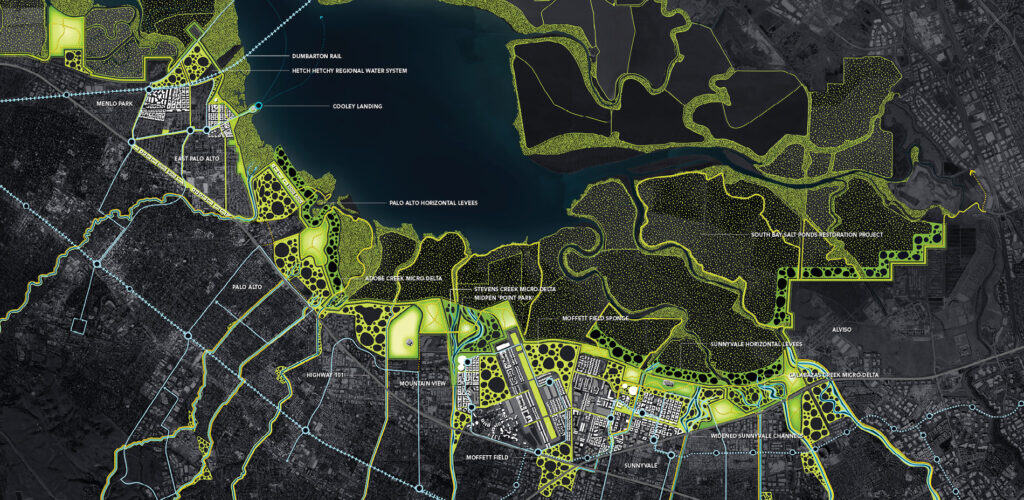
South Bay Sponge
The South Bay Sponge is a planning and design framework that thoughtfully imagines new, nature-inspired possibilities for climate adaptation that can grow in scale, incentivize investment, build public support and excitement, and facilitate coordination across jurisdictions.
Credit: Field Operations
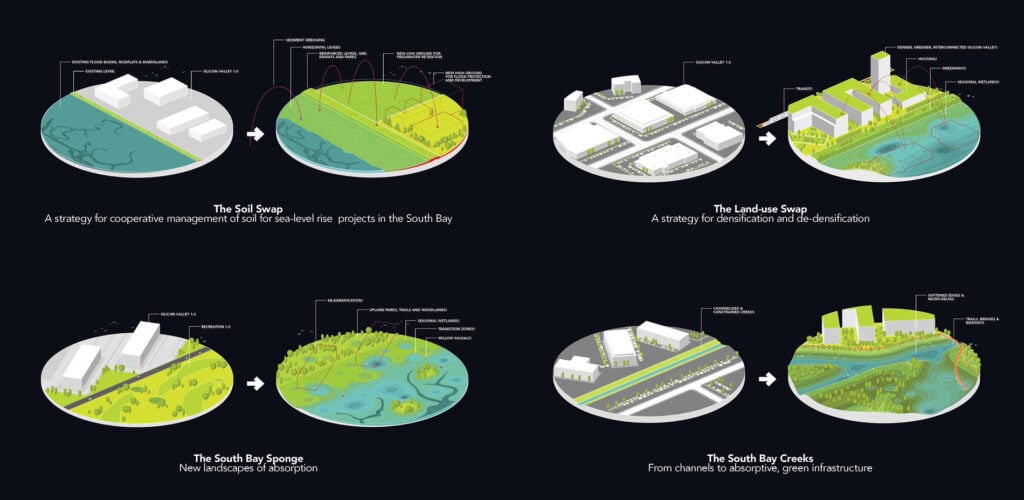
Four Regional Frameworks
The Sponge outlines four specific planning frameworks for resilience in the South Bay: “Soil Swap,” “Land-use Swap,” “Sponges,” and “Creeks.”
Credit: Field Operations

Community Outreach and Engagement
Through varied techniques for participation, the team identified challenges and obstacles facing large-scale resiliency initiatives in the South Bay; built enthusiasm; and identified agencies, organizations, and individuals that serve as advisors and promoters of the South Bay Sponge initiative.
Credit: Field Operations
The City of East Palo Alto secured a $17.3M grant from the California Office of Emergency Services for a levee system, complementing prior flood-prevention efforts to protect nearly 5,000 residents and 1,500 properties in neighborhoods within the FEMA floodplain. The Sponge helped elevate urgency while articulating social and environmental opportunities. In sum, it provides a holistic framework for shoreline adaptation, infrastructure, planning, and communication—advancing cooperation, policy, and equity at metropolitan scale.