


In this lecture, Patrick MacLeamy, founder of BuildingSmart International, presents the concept of the “curve of effort,” revealing how traditional architectural practice misallocates time and resources—spending up to 75% on non-design tasks. Through his analysis, MacLeamy demonstrates how shifting effort earlier in the design process, supported by Building Information Modeling (BIM), can prevent costly inefficiencies, delays, and disputes. The video further explores how Integrated Project Delivery (IPD) fosters early collaboration among all agents, and how BIM evolves into BAM (Building Assembly Manufacturing) and BOOM (Building Operation Management), redefining the construction process as a continuous, data-driven lifecycle.
Key Takeaways:
- Architects currently devote most of their time to non-design tasks, weakening project outcomes.
- Shifting design effort earlier reduces cost overruns and litigation risks.
- BIM enables precise coordination and efficient collaboration across disciplines.
- Integrated Project Delivery (IPD) ensures early, collective decision-making among stakeholders.
- The BIM–BAM–BOOM theory reframes design, construction, and operation as one digital continuum.
English Transcript:
And now we’re going to watch a video that will be very enlightening to start thinking about who should take part in our BIM Execution Plan. We haven’t left anyone out, and now we’ll see why. This is a video by Patrick MacLeamy, one of our professors. As you know, he’s the president and founder of Building Smart International, and what’s interesting is that we’re going to discover what the “curve of effort” is.
Architects are all about design. Owners hire architects for the purpose of designing buildings. They understand or expect that the work we do after design — to document the design and oversee construction to completion — is an automatic process. Nothing could be further from the truth. In fact, today’s architects spend about 75% of their time on non-design tasks and practicing what I call defensive architecture. As a result, design itself suffers from a lack of attention. Not enough time is put into thoroughly vetting the design to ensure it absolutely suits the client’s purposes. Why do we do this? And more importantly, what should we do about it?
A new strategy is needed to shift more effort toward design and away from other tasks. We need an examination of effort over time. Let’s start with a diagram where effort is measured over time. We architects traditionally begin to design with a design team, and the team and effort increase. Effort is at a maximum during construction documents. During bidding, effort is greatly reduced. Finally, a small effort is expended during the construction phase.
What else takes place when we work this way? Our ability to easily change design is very great at the very beginning. For example, we can make the building twice as large or half as large in a few minutes. However, as more of the design is documented, change becomes more difficult. By late construction documents, our ability to easily change design is gone. The other factor impacting our work is our ability to control construction cost. In the design phase, we can change construction cost by changing the design of the building. But as more of the design is documented, change becomes more difficult. By the end of the construction documents, the only option to control cost is to downgrade finishes — a terrible option. Finally, if change is necessary during construction by means of a change order, it is the most expensive of all.
If the building program and budget are not solved by this point, the project will fail. In this case, we’ll have a difficult construction process and may end up in a final phase — the litigation phase. During this phase, we as architects are no longer in control of decision-making. Instead, decisions are made by lawyers, insurance companies, and judges. Clearly, this process is broken and needs to be replaced by Building Smart design. This strategy calls for shifting effort forward in time — more effort to develop and test design alternatives, and less effort for documentation. All made possible by new three-dimensional BIM (Building Information Modeling) software backed up by even newer testing and analysis software. Not only will our designs be better resolved, but also our coordination will be more precise and free of errors, leading to a smooth construction process and the elimination of the litigation phase.
The “curve of effort” is a video he made a decade ago, but it has served as the foundation for understanding how the construction sector is transformed by introducing BIM. He talks about the difficulty architects face in completing a project fully and on time. The fact that architects devote 75% of their activities to non-design tasks affects them enormously.
In this table or graph he presents, we see axes for effort and time. With traditional design, we see how this effort increases depending on the phase of the design, where the executive project phase concentrates the most effort — hence this much higher Gaussian curve. The graph includes two lines. One represents the ability to control cost, and we see how that ability is highest at the beginning of the process, because when we start a project and are told, “this project must have three floors” or “it must have five,” we can easily adjust.
Then a second line appears that, as you can see, starts from the bottom and rises — this is the cost impact derived from a design change. At the beginning, this cost is very low because it doesn’t really affect us. But as the project advances and we decide to add an underground parking level, it becomes impossible, and the cost skyrockets exponentially.
That’s why, where these two lines cross, we find the point of maximum effort, and from there the process declines until it leads to what he calls the litigation phase — meaning we were unable to deliver the project on time, we were unable to deliver it within the given budget, and we end up in court.
The solution is to try to shift this Gaussian curve, this “curve of effort,” as early as possible so that the maximum effort doesn’t coincide with the problem area where both lines cross, thus avoiding the litigation phase. It’s normal that in the United States they talk about the litigation phase — a phase in which the entire project and its construction are taken to court — because the system is extremely litigious. What we must do is simply try to avoid it.
Therefore, we see that the first thing we should do is ensure that all the agents participating are involved with us from the very beginning. This is what’s called IPD — Integrated Project Delivery — and it’s a collaborative contracting model.
So, we’ve seen the importance of having everyone who will collaborate with us on the BIM execution involved from the start. This means early contracting. We’ll see in the next chapter how this early integration takes place through Integrated Project Delivery.
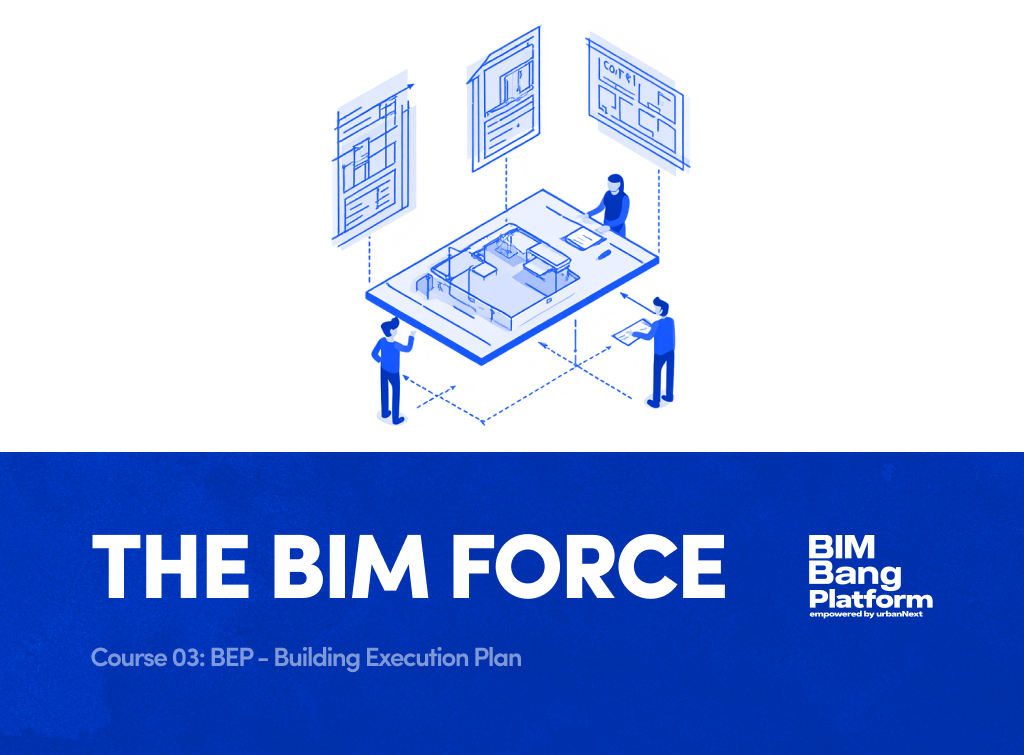
What we must avoid, let’s remember, is a situation where there’s an absolute disconnection among all trades across each phase. What we’re going to do is remove these “wooden doors,” these “wooden fences” you see here, and integrate everyone by placing them at the same table — all the people who will take part in the process. That’s what makes it important that everyone is involved in the same project as early as possible — in the future construction and operation of what we’re going to build.
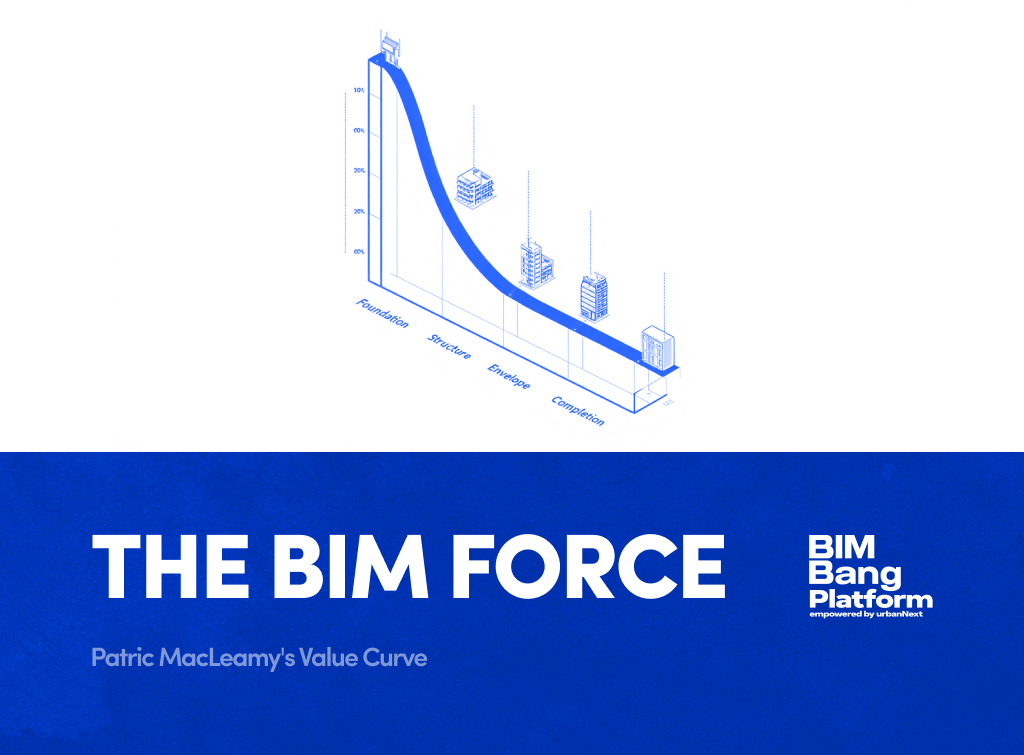
This means, as we can see in another graph — also from Patrick MacLeamy — with two axes, one for benefits and another for time, he introduces three variables, and this is very interesting. The idea is that when we invest one euro in the design or planning of a building or infrastructure, it transforms — he no longer calls it construction, he calls it assembly — it multiplies by 20 during construction. Therefore, good design is important because it will affect those 20 euros of construction.
But also, building those 20 euros of construction well will become 70 euros. One euro becomes 20 euros, and 20 euros become 70 euros. This means that every euro we invest in a good BIM project will become 70 euros of maintenance over the next 50 years of an infrastructure or building.
And let’s not even consider if this infrastructure or building lasts not 50 but 60, 70, 80, 90, or 100 years. This ratio of 1 to 70 changes and multiplies even more when we’re talking about — say — an airport, a hotel, or a hospital, where those 70 euros become 200 or even 2000 euros spent over these phases.
BIM — Building Information Modeling — the project we’ll be working on, this digital model, becomes BAM — Building Assembly Manufacturing — shifting from talking about construction to talking about fabrication and assembly. And this then becomes what they call BOM — Building Operation Management — corresponding to that seventh dimension of asset management and facility management for the next fifty to one hundred years of that infrastructure’s life.
Therefore, we reach the conclusion of this theory that BIM becomes BAM to become BOM. Hence, this “BIM BAM BOOM Theory” shows that in the digital age, the most important thing is data. And for that, the best and most essential methodology in this digital age where we need to produce data is collaborative work — because we will not have more or better information unless everyone participating in this process shares it with us.
Therefore, this is why IPD is so important — and that’s what we’ll be discussing in the next episode.