


La Ciénaga Grande is part of the Valley of a Hundred Waters, the largest laguna complex in Colombia, home to 12 acres of coastal wetland and mangrove forests and over 500 square miles of water. Fed by the mighty Rio Magdalena and by crystalline rivers flowing down from Sierra Nevada Mountain range in Santa Marta, and by the Caribbean Sea, as well, the Ciénaga Grande provides shelter for 150 species of fish, 100 species of sea creatures, 190 species of birds and 276 species of plant life. Within its vast mangrove forests live monkeys, manatees, tigers, nutrias, fox, bats, boas, and iguanas. In addition to offering shelter to animals, the mangroves provide a natural barrier that keeps the ciénaga from flooding during heavy rains.
Indigenous communities have been living on the edge of the ciénaga for thousands of years. During the Spanish conquest and colony, they were given the right to exploit fish in the lagoon, and there are still several fishing towns located around the ciénaga. The establishment of large cattle ranches and industrial farmland, however, forced families off of their land and into the water from which they obtained their livelihood.
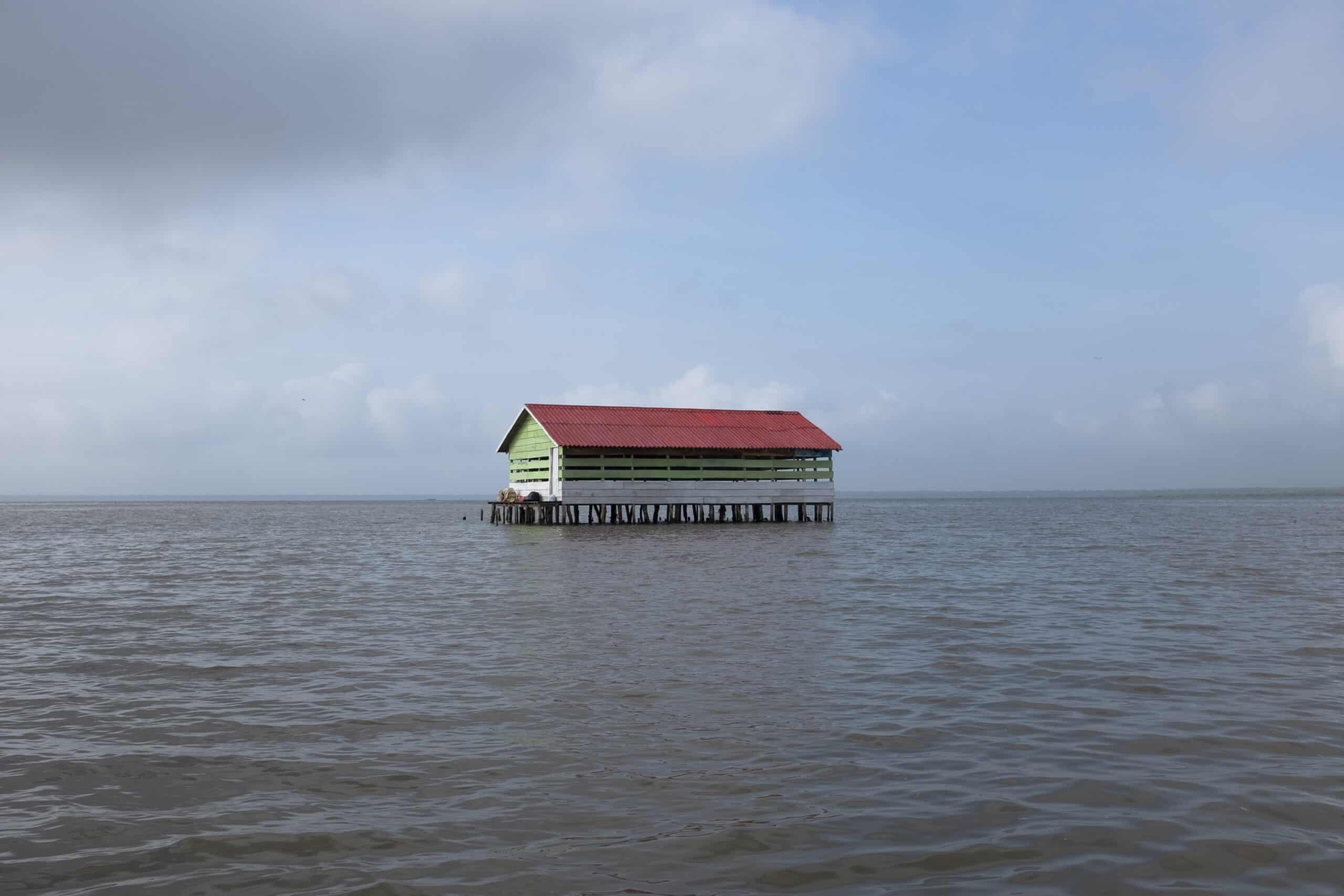
Nueva Venecia, established in 1847, is a town located in the middle of La Cienaga Grande, an hour-and-a-half motorboat ride from the nearest town on dry land. The initial cluster of rustic shacks on stilts sunk into the earth beneath the shallow waters that the fishermen built in order to be able to spend the night while fishing in the middle of the lagoon eventually took root and became a town.
Homes built on stilts, known as palafitos, have been around since the Neolithic period and are to be found across the globe. In Colombia, palafitos exist mostly on the Pacific and Atlantic coasts, as well as on major rivers, such as the Amazon. Ciénaga Grande, which is just around five feet deep, is a perfect site for these informal constructions, especially as the mangrove forest surrounding the ciénaga supplies the timber and palm leaves needed to construct houses.
Nueva Venecia currently has a population of 3,000 people and 400 houses, most made of wood. Besides providing cool air inside, wooden homes can easily be repaired and reassembled. After flooding, the wooden floorboards can be pulled up and the floors raised above the waterline. Concrete houses with zinc or asbestos roofs, however, are becoming more popular in town, considered an economic status symbol.
Although all homes are surrounded by water, some owners have created small plots of land adjacent to their homes by using garbage as landfill and use these small patios to raise chickens and pigs. Mangrove trees, which seem alien in a town without any land, sink roots beneath the shallow water and can grow so large they dwarf the houses next to them.
Local inhabitants have no deeds to their property and no one owns the land (or water) upon which their house sits. In theory, anyone can build a home in the town as long as they leave room enough for lanchas to drive between them and their neighbor’s house. In fact, though, only a few people (a biologist who has done research in La Cienaga Grande for years, the pastors of new Protestant temples) who are not part of the original families have been allowed to live or build a home in Nueva Venecia.
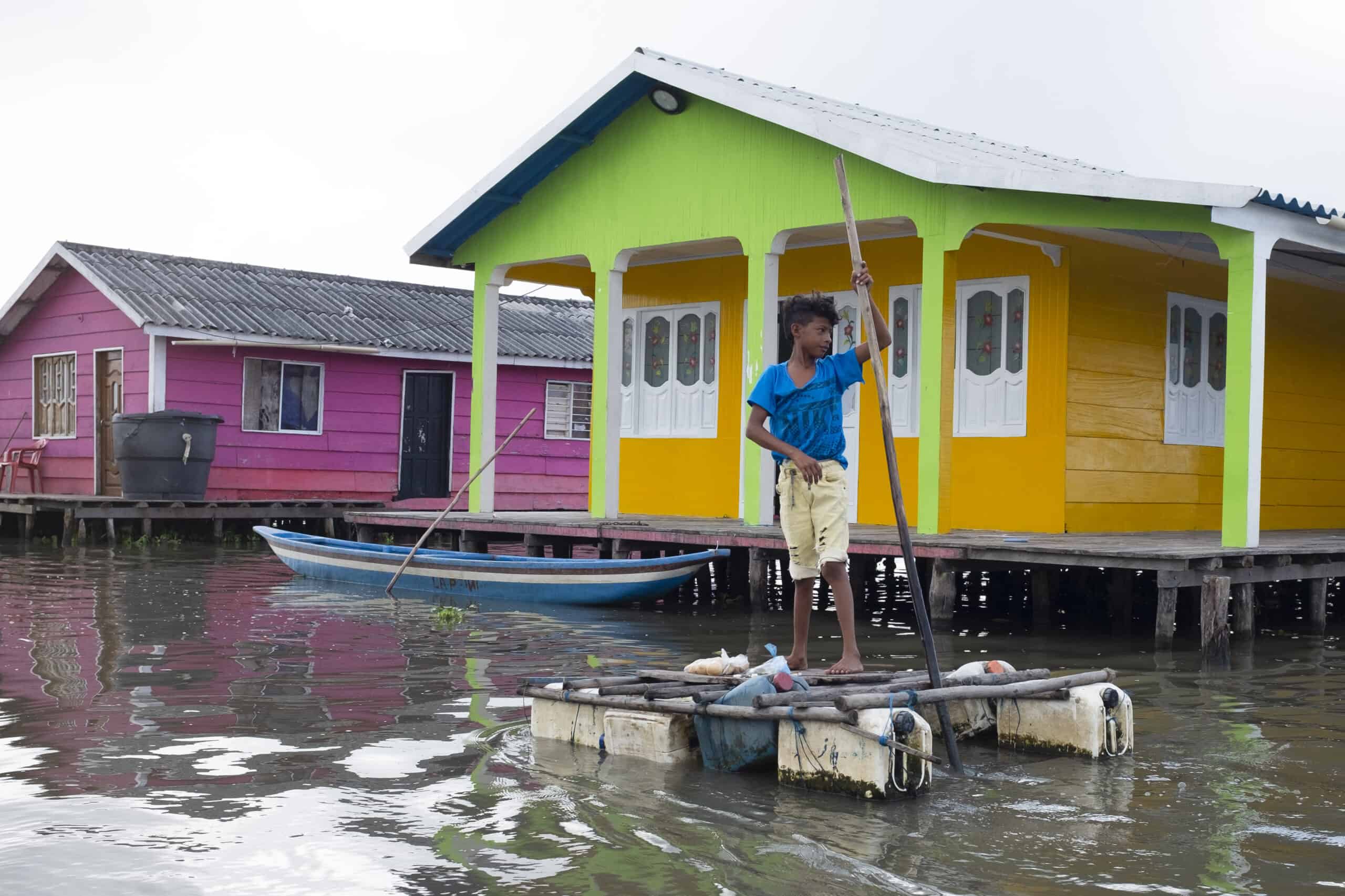
There are no street names because there are no streets. No one ever walks around town and it is impossible to even walk more than a few steps from one’s home without taking a plunge. To get around town, people use dozens of different kinds and different size boats, from small wooden canoes to large motor boats. Except for the most destitute families, who create their own flotation devices by recycling metal, plastic drums or other waste materials, most residents own a canoe to get around town. Instead of oars to row the boats, people walk the length of the canoe pushing the canoe forward with long wooden poles, much like Venetian gondoleers.
The fishermen in town use mostly small wooden canoes, but after the catch is packed into styrofoam containers and stacked onto a loading dock on the outskirts of town, six large lanchas with powerful outboard motors, each capable of carrying a ton of fresh fish, transport the fish to markets in towns on the banks of the lagoon. On the return trip, the lanchas bring meat, produce and dry goods to the town’s general store.
One lancha drives around town selling furniture and other goods not otherwise available in town. This floating store sells products with a lay-away plan, and athough the original price is reasonable, weekly payments add interest onto interest. Most everyone in Nueva Venecia has bought a wooden rocking chair from the floating store and most everyone in town owes money to the them.
A single saw mill in town cuts wood for the construction of canoes and funeral caskets. There is no cemetery in town so people must transport their dearly departed to be buried in towns on dry land. Funeral processions made up of long lines of boats accompany the corpse with music and singing to a cemetery across the lagoon.
The traditional wooden canoe made from mangrove forest timber, which has been used by locals for centuries, is now being displaced by fiberglass canoes, which although somewhat more expensive, tend to last longer. A workshop in which fiberglass canoes are built is located on the outskirts of town, as the fumes of the resins and other chemicals are toxic.
There is a large electrical generator in town but it often breaks down and even when it is working doesn’t service everyone. The one hotel in town, the general store, the main school, the police station, and the timber store and canoe-building workshop all have their own generators which they use as backup.
Water is everywhere in town but no one drinks a drop of it, mostly because the town itself is its own toilet. Human waste is dumped directly into the water below inhabitants’ homes without any residual water treatment. As a result, drinking water must be brought into town in deep-bed lanchas from a canal that forks off from Rio Magdalena more than an hour away, and before it is sold in town it must be treated with chlorine to kill off bacteria. Plastic bags or bottles of water are brought in by lancha, and the ice used in town is just long blocks frozen water in plastic bags.
The charitable foundation of Carlos Vives, the Colombian pop singer, donated a small water treatment plant. The water from the plant is pumped into the hull of a long boat (lancha del agua) and drivers are paid by the foundation to deliver the drinkable water free of charge to families that have school-age children.
A garbage collection cabin located on the outskirts of town receives non-organic garbage to be recycled in a nearby town but, even so, all types of non-organic garbage, especially plastic water bottles and bags, can be seen floating around town.
There is a single medical clinic in town, staffed with a full-time nurse and a doctor who comes into town two days a week to attend to the sick, and there is one drugstore in town, located in a large, traditional old home. If anyone gets seriously ill or injured, they have to be whisked to the closest town in a speedboat ambulance (also donated by Carlos Vives).
Nueva Venecia appears in several promotional material for the government, including in the video that accompanies the national anthem aired every day at 6am and 6pm on television. The brightly colored homes in the town might seem like a colorful local tradition but actually attest to the economic difficultires of the local residents, who receive financial aid, and buckets of paint, from European organizations and foundations.
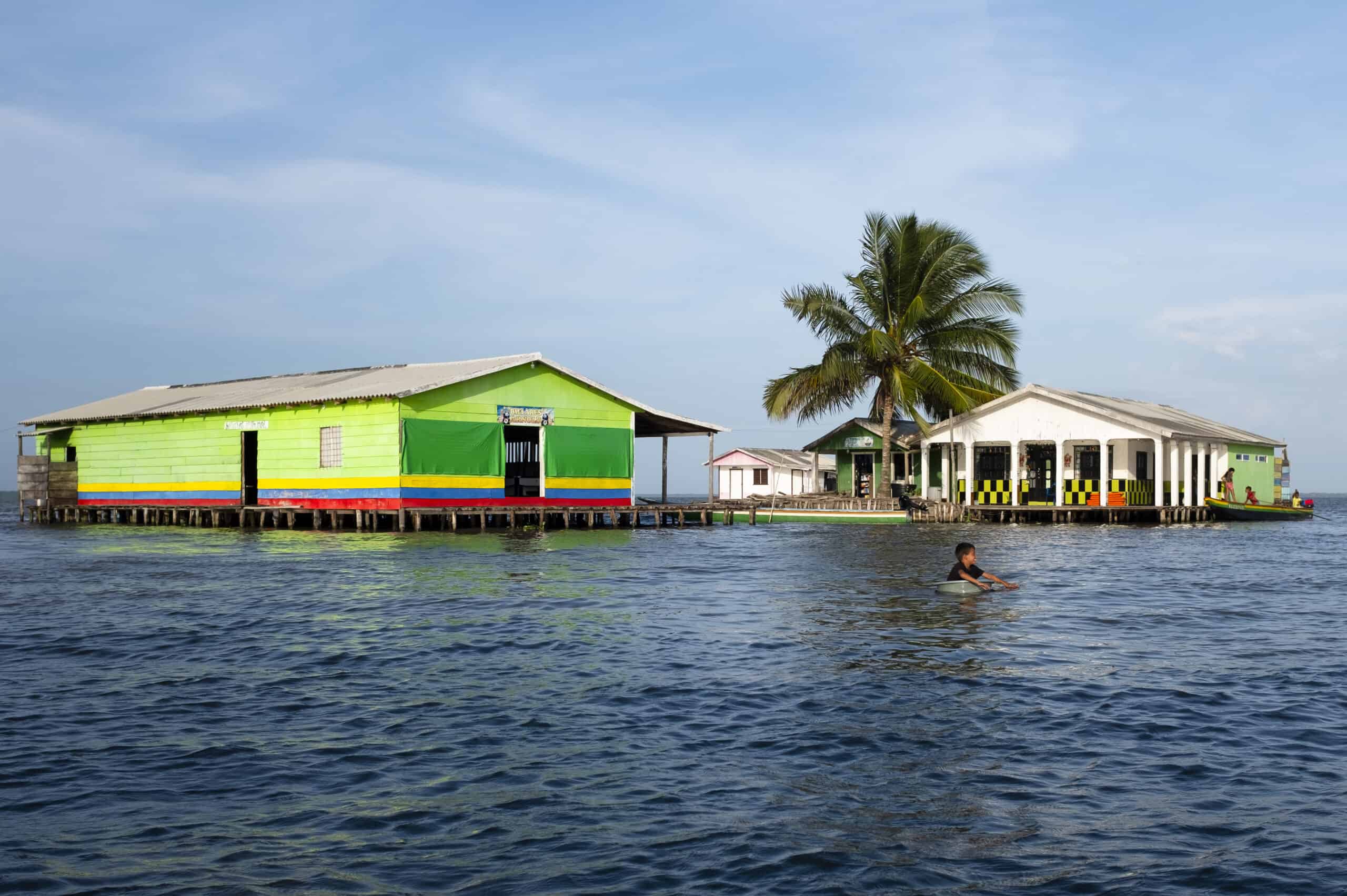
Without streets, plaza or parks, people in town rarely walk anywhere other than on their own porch. The only solid land in town where townspeople can congregate is the small concrete patio in front of the town’s only Catholic church. Next to the Catholic church is a new fullsized indoor soccer field with artificial turf and electric lights (fueled by the police station’s generator), a gift from Radamel Falcao, one of Colombia’s most successful international soccer players.
There are six pool halls distributed around Nueva Venecia. On weekends, loud music is blasted from giant speaker systems inside and young Venezuelan women are brought into the town to serve drinks and animate the clients. Traffic accidents are rare, except on weekends, when drunk men often crash their boats into each other and fights break out.
In Colombia, most of the violence and forced displacement is related to illegal land grabs and land invasions. In Nueva Venecia, being there is no land, the town should be free from the massacres occurring elsewhere in the country. Unfortunately, this has not been the case. Guerrilla groups have long been operating in the region, but since the 1980s paramilitary groups paid for by local landowners and businessmen began killing rebels and the locals who collaborated with them, and since 2000 there have been multiple massacres in Cienaga Grande.
In November 2000, Nueva Venecia was attacked by six lanchas carrying 70 paramilitaries dressed in Colombian military uniforms. Just outside of the town, 15 townsmen who were fishing in canoes were executed with knives and bayonets so as to not alarm the people in town with gunshots. Once in town, the paramilitaries rounded up everyone and executed 15 more men in the patio of the church (dozens of other residents were killed in their homes or attempting to flee). After the massacre, Nueva Venecia was abandoned by its inhabitants, but two years later, having found it extremely difficult to adapt to life on land and to earn a living from anything other than fishing, most everyone returned. A police station was installed in town, manned by six officers, to prevent another massacre.
Violence is not the only, nor even the greatest threat to Nueva Venecia. Located in the middle of a giant lagoon surrounded by mangrove forests, the town’s fate is tied to this rich ecosystem. In 1956, El Troncal, a two-lane coastal highway which runs alongside the cienaga for miles, was built to join the cities of Santa Marta and Baranquilla. El Troncal connected tiny islands between the cienaga and the Caribbean, displacing the campesinos and indigenous communities living there, and transformed the tropical islands into dusty, concrete roadside villages.
El Troncal also effectively cut off the Caribbean Sea from La cienaga grande, which depended upon the flow of saltwater from the sea to maintain its salinity, thus severely disrupting the cienaga’s delicate equilibrium. As a result, 3 million square feet of mangrove forest withered and died, creating not just one of Colombia’s greatest environmental disasters but also a major economic disaster for local fishing communities, including Nueva Venecia.
Years later, the mangrove was partially restored by opening up small passageways underneath the highway that allowed for the flow of water between the ocean and the lagoon (although these tunnels often get clogged by garbage), and also by cutting a wide swath through the mangroves to allow the water from Rio Magdalena to flow into the lagoon. Nevertheless, the mangrove forests never fully regained their biodiversity and their health is still delicate.
In addition to El Troncal, the cienaga has long been threatened by the works of man on all sides. Land invaders, cattle ranchers and industrial palm oil, rice and banana farmers have all deforested large tracts of land within the mangrove forest, redirected the flow of rivers for their own use (thus affecting water and salt levels in the lagoon), and have dumped huge quantities of human and man-made waste, including toxic fertilizers and pesticides, into the lagoon’s water. These are the same people who order paramilitaries to intimidate or execute locals when they complain about such environmental disasters.
In addition to the negative impact of local landowners and criminal organizations, global warming represents a very real threat to the mangrove forests and the cienaga, and to Nueva Venecia, as well. Climate change will increasingly affect temperatures, sea levels and rainfall, all of which can in turn affect the precarious equilibrium that sustains the mangroves and the cienaga. Changes in salinity within the cienaga have already led to several instances of massive fish deaths over the past few decades. Due to the shallowness of the cienaga, rising temperatures could lead to drought and to the drying out of the cienaga, which would spell the end of life there, both animal and human.
Despite the disastrous effects that El Troncal has had on the region, plans are currently in the works for expanding it into a four-lane freeway. It is doubtful that the enlarged roadway will help alleviate the daily traffic jams between Baranquilla and Santa Marta but, without a doubt, the massive quantity of concrete and asphalt added and the increased traffic flow will not only add to the pollution, garbage, and noise in the cienaga, but will also lead to higher temperatures in the area. Scrapping the old highway and building an elevated one would allow the sea and the cienaga to naturally nourish each other and thus ensure the survival of the mangrove forests, but the government is unwilling to spend what it would take, even though environmental damages will surely be greater.
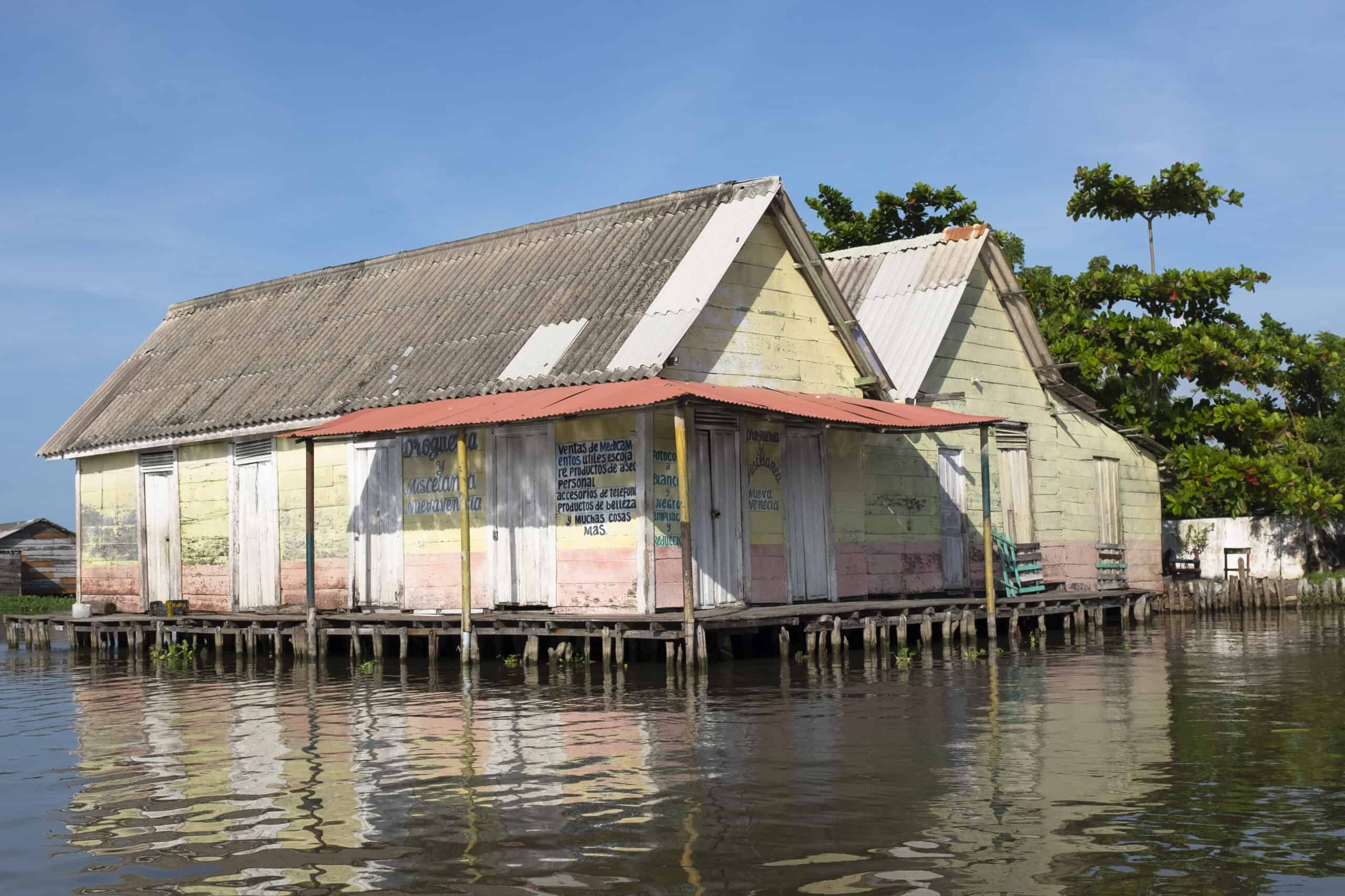
Even though Nueva Venecia is an aquatic oasis, far from the maddening crowds of Colombia’s Caribbean coast, it is nonetheless dependent on the world around it. The town is locked into an economic cycle of selling fish in markets outside the lagoon and importing all of its food and drinking water from these towns. Tourism brings in a bit of income, but being that it is a long trip for just a day tour, it is not constant and the profits go to just a couple of families.
The town of Nueva Venecia is not yet so densely populated or overrun by tourists that it is killing off its own natural resources, but it is still growing and can eventually, if there continues to be no human or organic waste treatment, become a risk to the health of its own inhabitants. However, if the water of the town is kept clean, hydroponic or “floating” gardens could easily be constructed throughout the town to supply the vegetable needs of the inhabitants, improving the local diet and decreasing its dependency on the world beyond its waters. Using traditional materials for the construction of homes and canoes, widely available in the mangrove forests on the banks of the lagoon, would also help keep toxic chemicals and concrete out of the area. The cienaga’s ecosystems have long provided Nueva Venecia with everything it needs, but the town’s survival in the long run depends on how this great gift of nature is treated.