


The redensification of the neighbourhood left the building and the small surrounding garden encased between two large dividing walls. The new complex of facilities takes on the challenge of giving a new life to the existing building and gardens by incorporating them into a new building with low environmental impact and reduced energy consumption.
Vil·la Urània is a small residence from the late 19th century that was home to the renowned astronomer Josep Comas i Solà, in the district of Sarrià-Sant Gervasi in Barcelona.
The redensification of the neighbourhood left the building and the small surrounding garden encased between two large dividing walls. The new complex of facilities takes on the challenge of giving a new life to the existing building and gardens by incorporating them into a new building with low environmental impact and reduced energy consumption.
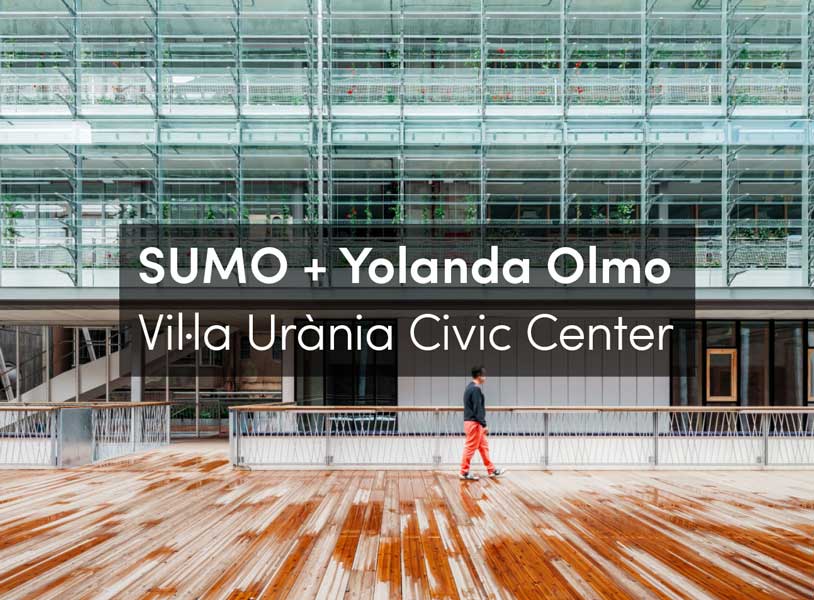
The new facilities, with more than 3200 m2, stand out for the use of intermediate spaces, which are naturally heated, closed off by a large façade formed by several overlapping filters that adapt to the external conditions, providing a green wall that accompanies the users in all their activities.

The pre-existing construction sets the ground level and the first floor for the whole complex. A dual access communicates the streets adjoining the plot. An adapted ramp path and an external staircase resolve the vertical communications The lightness of outdoor staircase increases ventilation and ensures a soft connection with neighbours that look out toward the building. The villa becomes the hub of the complex.
 The extension is conceived as a tall narrow building oriented toward the southeast with a large gallery, a semi-detached greenhouse, a passive system to warm and cool the meeting areas and zones for informal activities as well as the circulation areas. This intermediate space works as a winter greenhouse and as a shaded area in summer, and acts as a thermal buffer by separating the heated areas from the outside, reducing the building’s energy demand. The façade adapts automatically to outdoor conditions. Indoor temperature sensors act on the glass façade, opening it completely when necessary. Outside sensors measure solar radiation by acting on the folding shutters in summer. The inner vegetation formed by different species provides a pleasant sensation of coolness in summer, while its volume shrinks in winter to allow for increased sun exposure. The building envelope has been designed to achieve low thermal transmittance, minimize thermal bridges and keep out moisture.


The building is notable for its intense use of materials with a low environmental impact that are recycled and renewable. This includes wooden structures and wooden carpentry, wood-aluminium curtain walls or hemp fibre isolation panels.

Vil.la Urània was designed as a Nearly zero-energy building (nZEB). Its energy consumption is very low and part of the required energy is generated by building itself. Highly efficient active systems have been installed. There is a geothermal heat pump with 11 wells 100m deep to provide heating and cooling and hot water production. The lighting uses LEDs and it has photovoltaic production with 19kWpic installed. A 20,000-litre capacity underground tank collects rainwater to be used in the irrigation systems for the green wall.
The building was awarded a Class A energy certification and a LEED Platinum certification.