


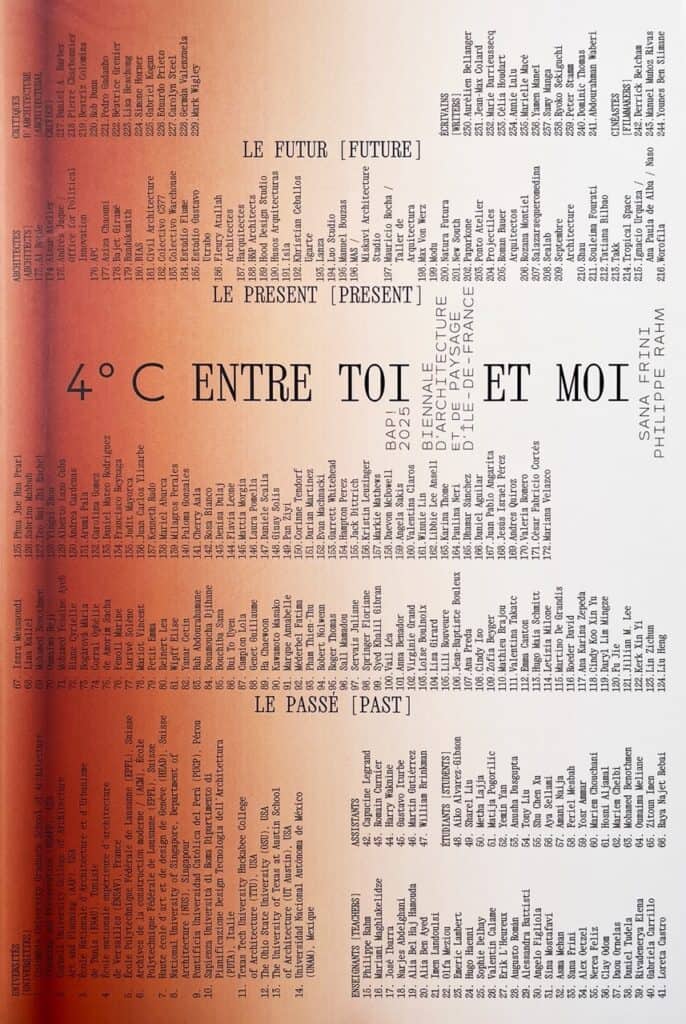
In Four Degrees Celsius Between You and Me, curators Philippe Rahm and Sana Frini reframe architectural discourse in the face of climate transformation. Grounded in their own contrasting geographic backgrounds—Frini from semi-arid Tunisia and Rahm from temperate Switzerland—the exhibition presents a vivid, data-informed argument for revising architectural vocabularies and techniques as global temperatures rise. Rahm details how climate migration—estimated at one meter per hour from the equator toward the poles—is reshaping the built environment. Through the work of 58 contemporary architects and collaboration with universities worldwide, the exhibition collects vernacular techniques—from Neftah’s wind-channeling streets to subterranean cooling and evaporative courtyards—that offer resilient, low-energy alternatives to mechanical air conditioning.
Architectural form, once driven by aesthetic language and symbolism, is now being reevaluated through the lens of thermal performance, CO₂ emissions, and resource resilience. The exhibition advocates for a shift from “super-structural” to “infrastructural” thinking—emphasizing material performance, passive cooling, and climate-specific adaptations to shape how and where we build in the 21st century.
Key Takeaways:
- Climate zones are shifting northward at one meter per hour, transforming regional design imperatives.
- Passive cooling methods—convection, conduction, evaporation, radiation—must replace reliance on air conditioning.
- Architectural elements like domes, shutters, and high ceilings had scientific cooling functions, not just symbolic ones.
- Materials like marble or ceramics were historically selected for thermal performance—not luxury.
- A new infrastructural lens in architecture prioritizes material behavior over stylistic expression.