


Introduction
The digitalization of every single component of cities has become a commodity in recent times, as the last iteration of the broader concept of smart cities (Cureton & Dunn, 2020). Urban Digital Twins (UDTs) aims to bring urban analytics to the next level. They represent more tangible, actionable, and concrete realizations of smart cities, which involve real-time data collection, analysis, modeling, simulation, prediction, and feedback into the city. Consequently, they are expected to help and enhance urban planning and operations to increase the quality and sustainability of cities. Overall, they involve data acquisition, analysis, visualization, prediction, and interaction expanded over the whole cycle of life of cities. Beyond technical and operational challenges, this article aims at repositioning the concept of UDTs by highlighting societal and experiential implications resulting from the rise of multiple co-existing examples that match metaverse visions that ultimately could reinforce difference realities and social divides.
Many urban digital doubles: from models to twins
Digital Twins were originally coined within the context of manufacturing management (Grieves, 2014) and spatial exploration (Glaessgen & Stargel, 2012), echoing earlier visions of digital worlds (Gelernter, 1991). This initial definition already summarized the most important ideas of digital twins: mirroring physical assets in a virtual environment as accurately as possible to improve operations efficiency through real-time monitoring or prediction of the life cycle.
As such, they referred initially to closed, deterministic systems and environments where control theory postulates (Cardoso Llach, 2012; Wiener, 1961) could be easily applied as elements, interactions and limits of the system were well-defined. Hence, uncertainty and unpredictability issues due to complexity were manageable. However, over the years, the idea of digital twins has evolved and become more sophisticated, and therefore more capabilities are expected from them.
Digital twins have become common across multiple fields such as health, drug development, aviation, manufacturing, climate, agriculture or infrastructure management (Bruynseels et al., 2018; Errandonea et al., 2020; Fuller et al., 2020; Guo & Lv, 2022; Kanaga Priya & Reethika, 2024). This illustrates how they span through multiple scales, from molecules to people or the entire planet. Particularly, their application to the built environment has found a very fertile ground for development. It continues the tradition of urban modeling since the mid-twentieth century (Batty, 2009; Forrester, 1969; Hunt et al., 2005; Iacono et al., 2008; Lowry, 1964; Moeckel, 2018). It expands the last decade’s industry and governance discourse around smart cities for increasing efficiency, optimizing processes, and improving the sustainability of cities using technology, sensing, and data. In this sense, digital twins can be considered their last iteration or even implementation (Deren et al., 2021).
Cities are particularly attractive for the development of digital twins. They are multi-scalar complex systems, the result of bottom-up and top-down processes, with a rich grand volume of data generated by intensive monitoring. This high availability of data is also the result of the convergence of well-established preexisting technologies to virtualize the physical built environment such as Geographical Information Systems (GIS), Building and City Information Modelling (BIM/CIM) technologies, ubiquitous sensing using the Internet of Things (IoT), integrated into 3D city models (Biljecki et al., 2015; Lehtola et al., 2022), and more recently everything merging into new standards for representing city elements, such as CityGML 3.0 (Kutzner et al., 2020).
However, different than in easier-to-control manufacturing environments, UDTs face bigger challenges. Cities are complex open systems, in constant change, which are usually defined as “wicked” problems (Rittel & Webber, 1973). Additionally, they involve not only tangible measurable and physical aspects frequently associated with the “static” built environment, but even most of what shapes cities is a myriad of intrinsically human socio-economic and cultural processes (Batty, 2024). Thereby, the definition of UDTs and their expected capabilities are still highly ambiguous (Depretre et al., 2022; Shahat et al., 2021).
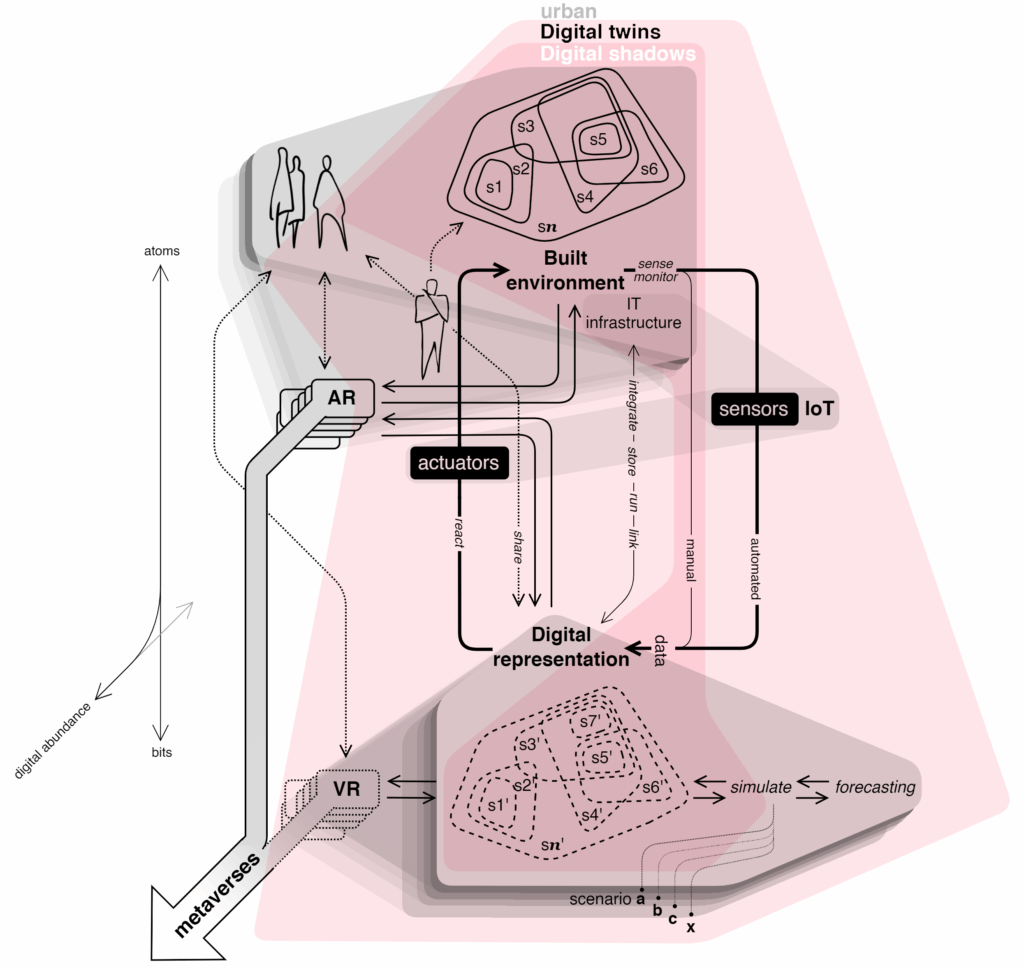
These digital representations of cities and their built environment, physical counterparts are aimed to be linked through real-time bidirectional interactions and data flows, which make possible automatic data collection from the physical world, and feedback, or even change, from the digital representation back into the physical realm (Sepasgozar, 2021). This automatic feedback between physical and virtual realms is the main feature that distinguishes digital twins from other digital doubles such as GIS, BIM, and CIM (Masoumi et al., 2023; Shahat et al., 2021), or city control systems. The market-driven popularization of the UDT concept has rebranded (Kim et al., 2021) many of these originally considered digital shadows technologies (Sepasgozar, 2021), whose focus is rather in data aggregation, visualization, and communication. Now, they are seen as early-stage implementations of UDTs within larger recently proposed frameworks to try to systemize the whole ecosystem of digital doubles for cities (Gerber et al., 2019; Haraguchi et al., 2024; Kim et al., 2021; Masoumi et al., 2023; Raes et al., 2022; White et al., 2021).
| Dimension | Digital shadows (traditional urban models) | Urban Digital Twins (as presented in this article) |
|---|---|---|
| Data flow | One-way data flows from the physical world to the digital representation | Two-ways data flow with (near) real-time updates and feedback loops between the physical realm and digital representation |
| Purpose | Focus on visualization and accurate, static replication for observation | Dynamic models for simulation, scenario planning, and active management |
| Representation | Singular, isolated, and centralized representation of urban systems | Dynamic, multi-dimensional models integrating various systems, data, and scales |
| Stakeholder involvement | Limited involvement, usually technocratic and corporative oriented | Participation of multiple stakeholders, including policymakers and citizens |
| Impact on Urban experience | Minimal focus on user or social interaction | Actively able to shape differential and tailored urban experiences, promoting either customization, inclusion, and accessibility or social divisiveness |
| Societal impact | Minimal focus on societal consequences, limited to the scope of the policies that they may inform | Politically and socially loaded, with the potential to create fragmented urban realities |
Table 1: Summary of main differences between traditional urban models (e.g. digital shadows) and the proposed framing for UDTs.
Consequently, the term “digital twin” has become ambiguous, and it spans from more or less advanced expanded implementations of city models to the most recent approaches, which incorporate real-time information feedback loops and complex simulations of socio-technical systems. We can consider all of them as urban digital doubles, being the former models and digital shadows, and the later, gradually closer to the idea of proper digital twins (Fig. 1 and Table 1). This most accomplished vision of digital twins requires the integration of simulation and optimization with the processing of massive volumes of low-latency data, which involves ubiquitous sensing and great computational power (Liu et al., 2021; Wang et al., 2019). However, no example exists yet that integrates all the expected features, although academia, industry, and government may envision to grand scale digital twin as the ultimate goal (Lim et al., 2022; Nativi et al., 2021). The rest of the article will focus on these more advanced, interactive, complex, and still-to-be-developed UDTs.
Coupling with reality and the emergence of metaverses
There could be some fuzzy agreement about the general capabilities that an UDT should tend to have, differentiating them from other digital doubles of cities: “integrated models based on 4D (i.e. spatio-temporal), relational and sensor interoperable, open data which could be used for simulation and prediction at different spatial and temporal scales” (Ketzler et al., 2020). Nevertheless, there is still a very wide range of possible levels of accomplishment for a digital twin (Evans et al., 2019). At the same time, it is more unclear the actual nature and expectations of a digital twin regarding coupling, interaction, feedback, and closeness to the physical reality. On one hand, in the short-term and high-frequency scope, (Batty, 2018) a close coupling is expected between the physical reality and its representation in such a way that the collection of data should inform and be processed automatically, and in real-time by the model to provide immediate feedback that can support constant readjusting and optimization of the physical reality. This approach would be more related to continuous operations and management and requires a tight coupling between physical assets and their representation (Tomko & Winter, 2019). As a result, the digital twin can be considered as an integral part of the physical system, now rather a cyber-physical-social system. A complementary perspective is the speculative and longer-term, low-frequency city, in which the virtual representation needs to detach from reality to explore alternative, never-existing, scenarios which ultimately can inform future operations. As such, a tight coupling, a mere mirrored representation of the physical reality would limit the exploration of alternative scenarios, which precisely requires detaching from the physical reference (Batty, 2018). Hence, this understanding of UDTs represents a first methodological divergence or split from reality.
This multiplicity of urban scenarios can be particularly enhanced by Extended reality (XR), whether in the form of virtual (VR), mixed (MR), or augmented reality (AR) (Rosenberg, 2022). Expanding the cyberpunk original science fiction concept (Gibson, 1984; Stephenson, 1994), urban metaverses can be understood as several collective virtual shared spaces mirroring and expanding existing cities where people can interact, work, play, and socialize in real-time using avatars and digital identities with a plausible sense of presence (Ball, 2022). They can take the form of different XRs, whether as completely virtual environments or as virtual layers on top of the physical reality that is augmented, while they could consist of multiple coexisting and interconnected XRs (Rosenberg, 2022) (thereby, we would talk rather of a metaverse of metaverses). Every stakeholder involved in city planning can come to the urban metaverse, participate, and exchange ideas to reach a consensus (Dembski et al., 2020; Helbing et al., 2023). These spaces are characterized by their persistence, interoperability, and the ability for users to create and influence the environment and content within them in an open-ended way. Thereby, urban metaverses are all these possible expansions of the built environment made possible by the interplay, aggregation, and federation of UDTs and XR technologies to create a range of variations over the built environment in several dimensions as urban digital multiplicities:
- From augmented ones to fully virtual ones,
- From fully individually tailored to increasingly co-shared with other people,
- From tightly coupled with reality to sandboxes able to anticipate and test new speculative settings, policies, and designs for cities to be potentially generalized.
The limits of coupling, representation, and predictability
Any of these digital representations will be bounded by the very own nature of the data used (Helbing & Argota Sánchez-Vaquerizo, 2023) and by the decisions and methods involved in the curation of this data. A mere accumulation of big data processed by opaque and hard-to-understand and interpret machine-learning algorithms falls short. The lack of consideration of complex effects, interactions, and interdependencies (Caldarelli et al., 2023; Grieves & Vickers, 2016) contributes to the limitation of the digital representations of cities. Cities are the result of the interplay of bottom-up and top-down processes. As such, a system aiming at representing, analyzing, and forecasting the future of urban environments would try to get as close to the physical environment as possible. While assuming the simplification of our models (Batty, 2021) our current data-driven approaches over-represents physical assets and rely heavily on data analytics tools, perpetuating a restricted vision of cities as if they were soulless, asocial machines.
Considering simultaneously different models that are at least partially valid or useful may help to overcome the limitations of representing and modeling socio-economic, human systems of the physical world. (Helbing, 2013). Also, this incorporates multiple worldviews and approaches to problems which can be hard to be fully formalized and hence intrinsically wicked (Batty, 2021; Rittel & Webber, 1973). This pluralistic modeling could consist of many parallel, federated digital twins able to provide a more accurate picture of the systems, their interactions, and their future, by encapsulating the diversity, conflicts, and tensions of our real world (Gerber et al., 2019; Hudson-Smith et al., 2022; Page, 2018). While the understanding of human socioeconomic processes has improved over the last decades, it is still needed to define and model the relations between physical and socio-economic representations (Batty, 2018). Particularly, the inclusion of human, social, cultural, and psychological factors, hardly quantifiable and still fundamental for the quality of human settlements, is still a challenge in the representation of urban systems. However, it may be considered impossible to predict and forecast holistic future scenarios (Cureton & Dunn, 2020).
The representation and conceptualization of the city would benefit from:
- Combining data-based and hypothesis-based approaches based on theory linked to complexity science (Caldarelli et al., 2023), and
- Updating and enriching the way they codify and represent components, processes, knowledge, and relations happening in cities. Semantic representations (Chadzynski et al., 2022; von Richthofen et al., 2022) in digital twins developments can enable a better, richer, and more aligned representation of reality with human understanding.
Semantic approaches to data representation can unlock new possibilities for raw data used currently in urban planning, modeling, and urban codes:
- It enables making raw data more understandable, and ultimately, operationalizable, and
- It allows expanding the possibilities of their exploitation to address domain expert questions and challenges.
Overall, it faces some of the current issues on how much data is needed to accurately grasp, represent, or depict urban life. The question may be on how we represent and encode that data. This high-level approach aims to generate agnostic graph knowledge platforms with a potential global scope (Akroyd et al., 2021).
The role of people: participation
The role of humans in the development of UDTs, whether as operators, people-in-the-loop, or even simply as end-users, collaborators, or sources of information is one of the main challenges (Abdeen & Sepasgozar, 2022). People may have different considerations than planners and designers regarding the built environment, which adds to the unpredictability of environments that have not been planned for the unplannable (Gram-Hansen, 2017). In this sense, there is a public interest in engaging citizens in the utilization of UDTs to enrich, analyze, and forecast cities’ evolution (Yamu et al., 2023). It is promoted by international good practices and it is an increasingly common trend in cities as shown in many participatory and co-creation processes as fundamental for sustainable urban development (Bouzguenda et al., 2019). If cities are designed for the well-being of the people they house, citizens should be able to participate in their planning. Indeed, digital twins can be potentially examined and experienced by the general public to provide feedback on the proposed changes in the city (White et al., 2021). However, most of the development of digital twins has focused on the physical aspects of cities, with little role of people and social, economic, cultural, and behavioral processes (Batty, 2024). Also, we cannot disregard the well-known challenges of citizens’ participation in planning processes in cities even out of the context of digitalization, which usually includes misrepresentation, instrumentalization, and other forms of flawed participation (Blundell Jones et al., 2013). Alternatively, including citizens’ participation in UDTs can be used to increase situation awareness about future plans while providing an understandable interactive way that can overcome engagement obstacles for consultation processes (Ketzler et al., 2020).
People can play different roles in this process and may appear in different stages. From an interaction point of view, they can be the end users of a given framework, whether just as receivers of higher-quality information or actively participating in planning and decision-making processes. In the former, people can be simple users of digital frameworks and platforms for useful information; they can interact and elaborate on information together with other citizens. In the latter, they can be even the curators and creators of crowd-sourced data for these systems, if not really engaging and being part of planning support (Batty et al., 2012).
As any element is subject to be conceptualized, coded, analyzed, and planned, people are not only the prosumers and evaluators of data, frameworks, and resulting policies and planning decisions. They are also active constituents of the built environment whose behavior and cognition are subject to be analyzed and modeled. Their interactions with the built environment are usually not sufficiently represented and understood in our existing big data, from a cognitive, psychological, and cultural point of view. As active agents of urban systems, people interact in different ways between them, with other elements, with the environment, and with the tools available. XR has been proven to be very handful for research behavior in the built environment and to enhance the role of citizens as active agents of innovation, inclusion, and social development (Dembski et al., 2020; Hudson-Smith & Batty, 2023; Hudson-Smith et al., 2022; Sanchez-Sepulveda et al., 2019; VU.CITY, 2021; White et al., 2021). Also, mirroring the diversity involved in city shaping, and building successful and actionable UDTs demands the collaboration of multiple stakeholders with diverse expertise (Allam et al., 2022) and reflecting local knowledge (Nochta et al., 2021). It means, co-create tools for co-creation.
The use of computer intelligence to expand the capabilities of people to participate in the planning of changes in cities goes beyond mere interaction. One of the challenges of participation in urbanism, as in any deliberation and decision-making process, is the sharing and combination of different agendas, preferences, and opinions. Diversity is a feature of cities. Divergence is embedded in the experience of the city, not only from opinions and preferences. The same urban context, the same built environment, the same location, and features will be evaluated, appreciated, and perceived differently by different individuals (Pocock & Hudson, 1978). The current development of Artificial Intelligence (AI) aims at supporting democratic participatory processes from where people could expose and receive feedback from their fellows mediated by computational intelligence. It means digitally assisted deliberation and debate, to align opinions and preferences (Zaremba et al., 2023). From the understanding that (urban) digital twins require bidirectional flows of information, the role of stakeholders and people, in general, is even more important. Within this perspective, the feedback and directionality can be understood from a very computational, data-driven perspective. It is, in tangible and computable data flows between the physical reality and the virtual representation. However, it can be seen from a more cognitive, policy, and social perspective: directionality can be also informing people and interactions between human “operators” involved in the decision-making process and the virtual mirrored representation. In this context, the actuators would be the humans being affected by the digital twin.