


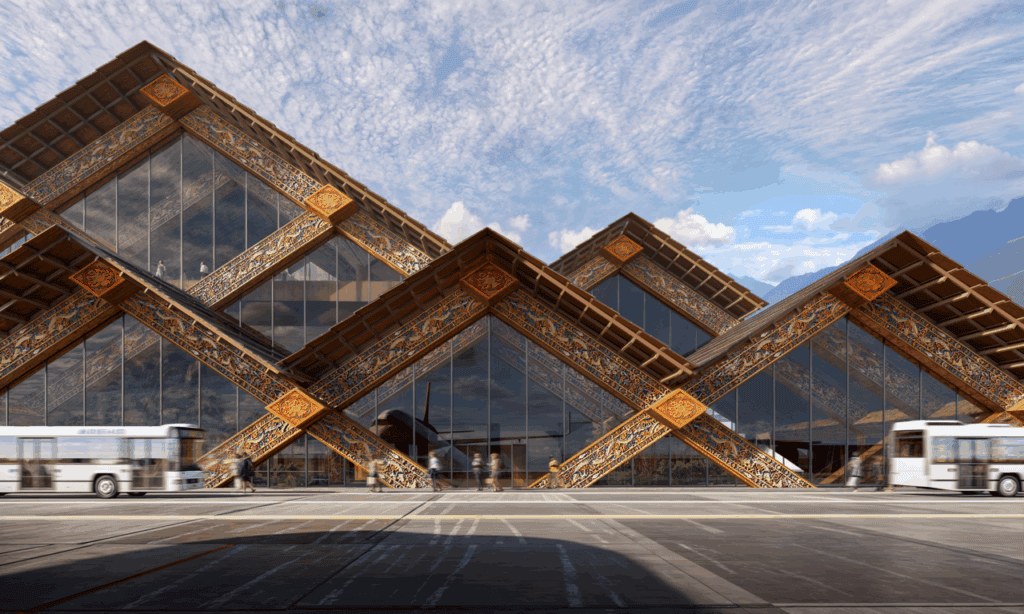
Blending traditional Bhutanese craftsmanship with contemporary innovation, the Gelephu International Airport is designed for mindful travel and future expansion. Its modular glulam-timber diagrid, adorned with painted carvings, will be showcased at the 2025 Venice Architecture Biennale, Ancient Future, from May to September.
Sited near the Bhutan–India border and the Paitha River, the 68,000 m² terminal sits within lush subtropical forest, mountains, and rivers. Developed with aviation engineering firm NACO, the project forms a key part of the Gelephu Mindfulness City (GMC) masterplan by BIG, Arup, and Cistri. The airport is planned to handle up to 123 flights daily and welcome 1.3 million passengers annually by 2040, rising to 5.5 million by 2065. An installation in Venice will feature a carved timber “diamond” from the façade, sculpted half by a Bhutanese artist and half by machine, to highlight the dialogue between heritage and technology.
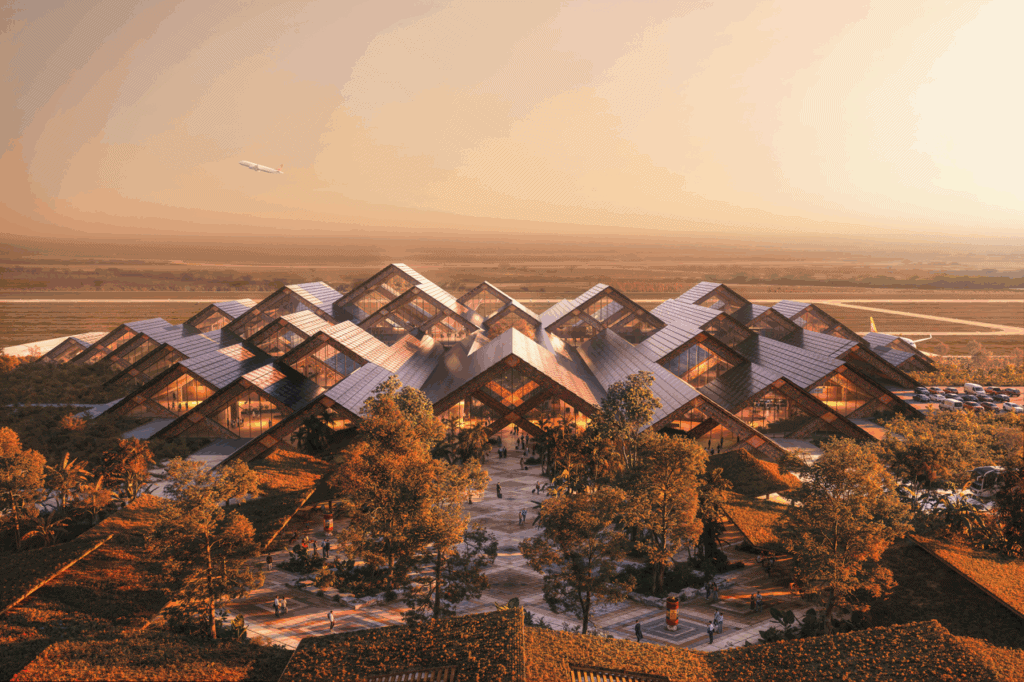
The arrival plaza comprises four planted zones referencing local forest ecologies. Paving in natural stone and integrated seating create a shaded gathering area beneath a protective canopy. Inside, a linear “Forest Spine” courtyard brings biodiversity corridors into the terminal, separating domestic (west) and international (east) operations and offering treetop walkways and indigenous flora visible from throughout the building.
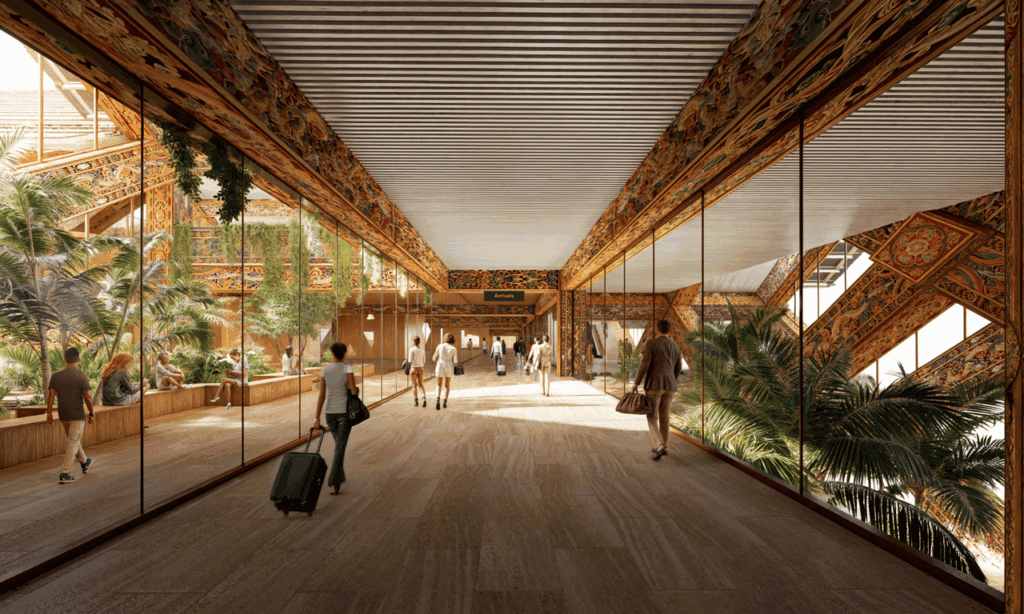
Passenger experience and operational clarity shape the layout: intuitive wayfinding, a smooth sequence from curb to gate, and upper-level gates paired with retail and F&B overlooking the apron and Himalayan landscape.
Responding to the subtropical climate, the design employs passive, climate-adaptive strategies rooted in Bhutanese architecture: moisture-modulating timber, ventilated roofs and courtyards for natural airflow, and deep eaves for rain and sun protection. The airport functions as Bhutan’s first inland mobility hub, integrating trackless trams and buses to Gelephu’s town center and beyond.
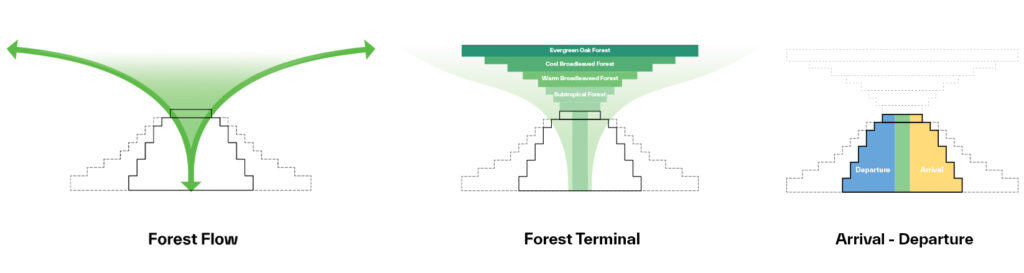
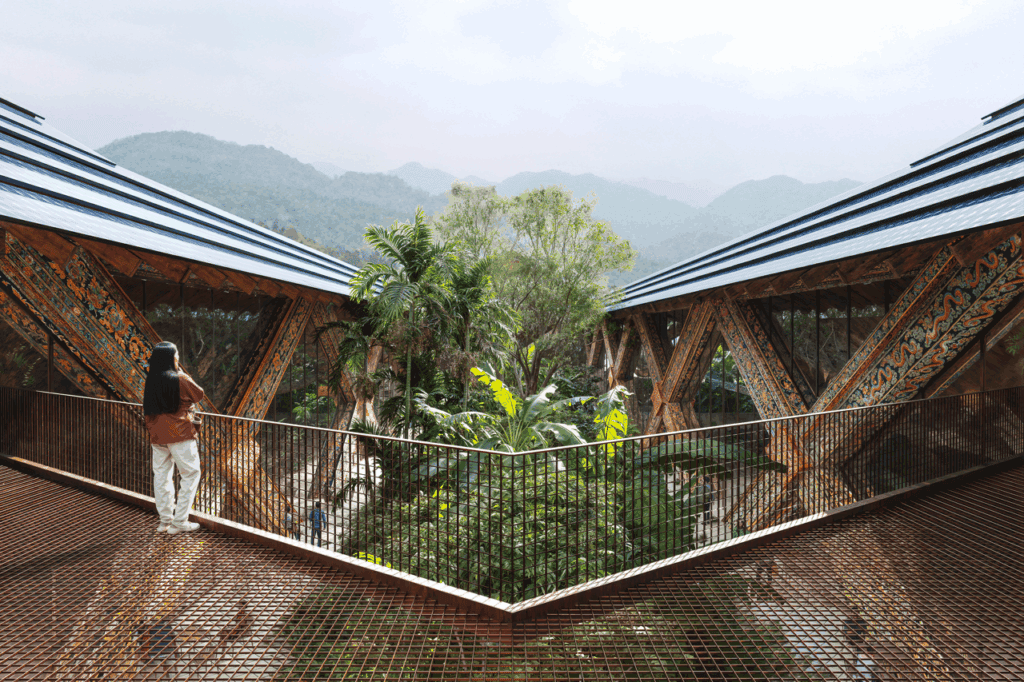
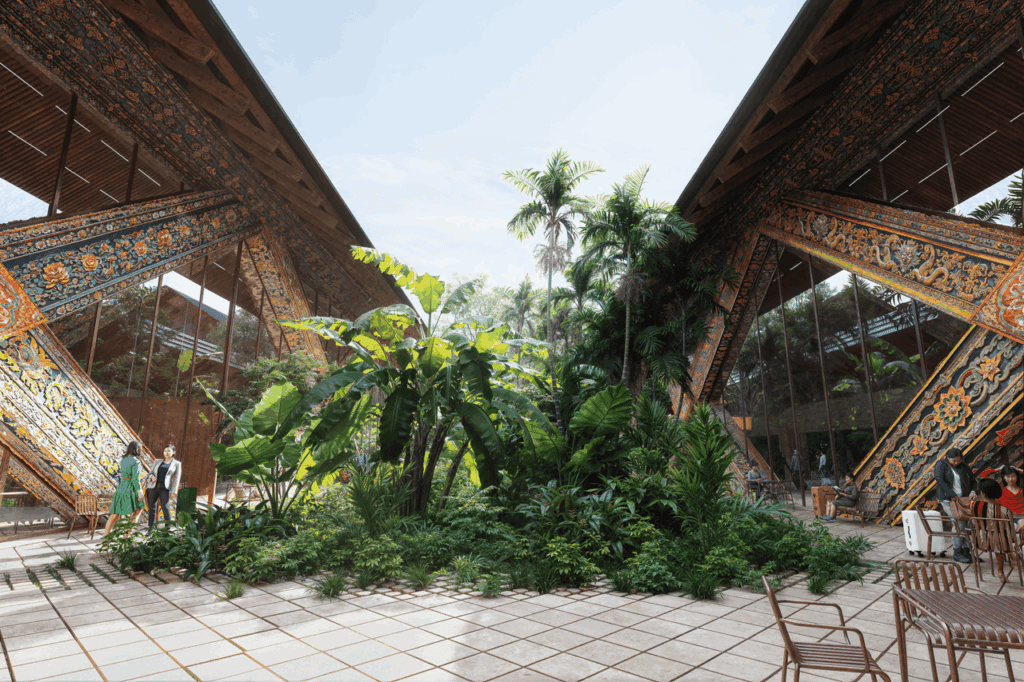
Craft is celebrated throughout—Shing-Zo (carpentry), Par-Zo (carving), Lha-Zo (painting), and Tshar-Zo (weaving). Daylit triple-height entries, floor-to-ceiling glazing, and skylights establish a calm atmosphere, while indoor and outdoor lounges support yoga, gong baths, and meditation.
Structurally independent mass-timber frames allow straightforward disassembly and phased expansion. The roof incorporates PV panels, reinforcing Bhutan’s carbon-negative trajectory. The painted façade references the “Kachen” pillar—an emblem of Bhutanese structural heritage and spiritual symbolism—while carved dragons signify past, present, and future.
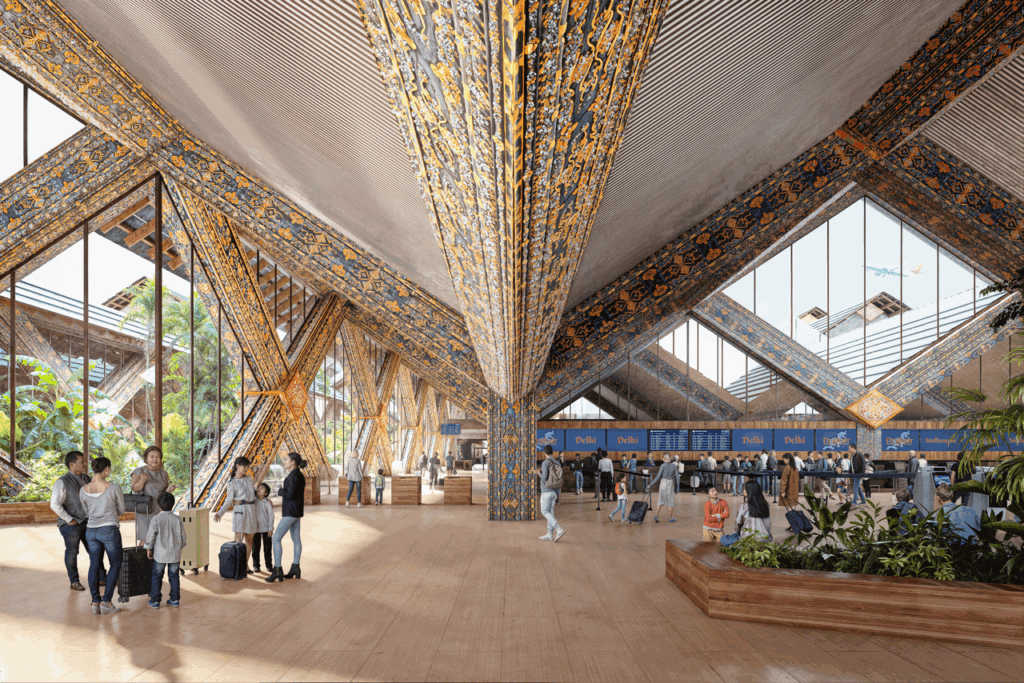
Gelephu International Airport is projected to open in 2029, positioning GMC as a regional aviation and public-transport hub while expressing Bhutan’s cultural and ecological values.